
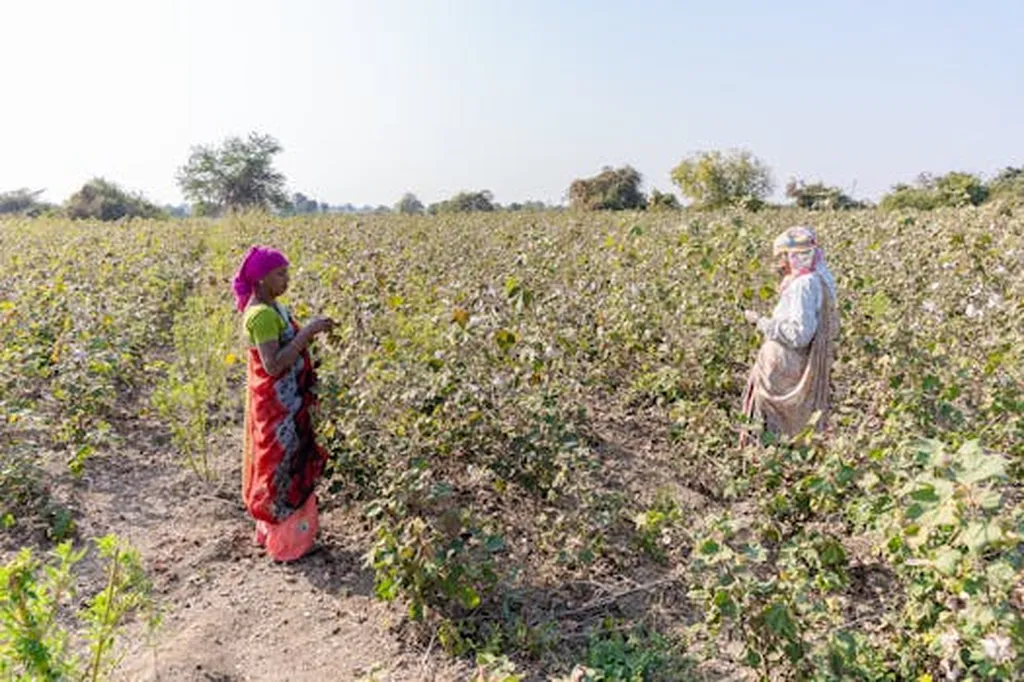
In the vast, sun-drenched fields of the Brazilian Cerrado, a technological revolution is underway, one that promises to reshape the way cotton farmers predict yields and manage their crops. A recent study published in *AgriEngineering* has demonstrated the potential of Sentinel-2 satellite imagery to provide reliable cotton yield predictions, offering a robust alternative to traditional harvester-based yield maps.
The research, led by Carlos Manoel Pedro Vaz of the Brazilian Agricultural Research Corporation (Embrapa Instrumentation) in São Carlos, Brazil, leverages vegetation indices (VIs) derived from Sentinel-2 satellite data to estimate cotton yields. The study analyzed data from 30 commercial plots across six cropping seasons (2019–2024), encompassing 76 plot-season datasets. By grouping vegetation indices into 15-day intervals based on days after sowing and applying a logistic growth function, the researchers developed regression models that could predict cotton yields with remarkable accuracy.
The results were impressive. At the pixel level, the models achieved a root mean square error (RMSE) of 0.695 t ha−1 and an R2 of 0.78, with the Enhanced Vegetation Index (EVI) performing slightly better than other indices. At the plot scale, the mean yield predictions across all datasets had an RMSE of 0.41 t ha−1, reflecting the higher reliability of module-based yield measurements.
“This study shows that Sentinel-2 satellite imagery can be a game-changer for cotton farmers in the Cerrado,” said Vaz. “The consistency and reliability of these predictions can help farmers make more informed decisions about variable-rate input management, ultimately improving their yields and profitability.”
The implications for the agriculture sector are significant. In large-scale systems like those in the Brazilian Cerrado, harvester-based yield maps are often inconsistent due to calibration errors, the use of multiple harvesters, and complex post-processing. Orbital remote sensing offers a consistent and scalable solution, providing vegetation index data that can be used for crop monitoring and yield estimation.
“The potential of Sentinel-2 VIs combined with logistic regression to predict cotton yields in the Cerrado is immense,” added Vaz. “This technology can complement or even replace harvester-based monitoring, providing farmers with a more reliable and cost-effective tool for precision agriculture.”
As the agriculture sector continues to embrace precision farming techniques, the integration of remote sensing technologies like Sentinel-2 satellite imagery is poised to play a pivotal role. This research not only highlights the immediate benefits for cotton farmers but also sets the stage for future developments in the field, paving the way for more sustainable and efficient agricultural practices.
The study, published in *AgriEngineering*, was led by Carlos Manoel Pedro Vaz of the Brazilian Agricultural Research Corporation (Embrapa Instrumentation) in São Carlos, Brazil.