
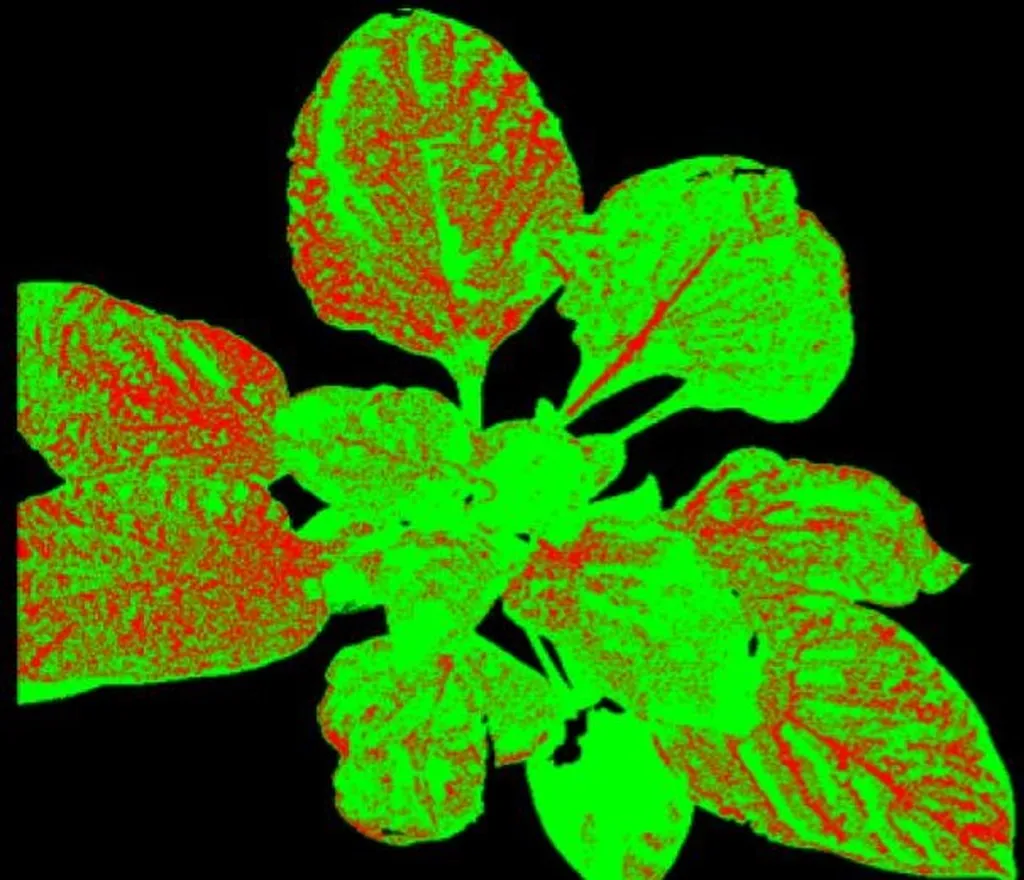
In the heart of the rubber plantations, a silent enemy lurks, threatening the livelihoods of countless farmers and the global rubber industry. Powdery mildew, caused by the fungal pathogen Oidium heveae Steinm., has been wreaking havoc on rubber trees, leading to significant economic losses. But a beacon of hope shines through the gloom, as researchers have developed a novel approach to monitor and manage this devastating disease.
In a study published in *Plant Methods*, a team led by Donghua Wang from the College of Water Resources Science and Engineering at Taiyuan University of Technology, has harnessed the power of hyperspectral remote sensing to classify the severity of rubber leaf powdery mildew. The research presents a groundbreaking framework that could revolutionize disease management in the rubber industry.
The study’s innovative approach involves extracting spectral features using three distinct methods: spectral mathematical transformations, continuous wavelet transformation, and vegetation indices. “We wanted to fully exploit the disease information within hyperspectral data,” Wang explains. “By combining features selected through correlation analysis, least absolute shrinkage and selection operator, and principal component analysis, we created fused feature sets that significantly improved model performance.”
The results were staggering. The fused feature set based on principal component analysis selection achieved an overall accuracy of 98.89% in classifying disease severity. This remarkable accuracy is a game-changer for the rubber industry, offering a powerful tool for early warning and effective management of powdery mildew.
The commercial impacts of this research are profound. By enabling large-scale dynamic disease monitoring using UAV and satellite platforms, this technology can help farmers and industry stakeholders make intelligent, data-driven decisions. “This framework lays a technical foundation for the transition of the natural rubber industry from experience-based control to intelligent decision-making,” Wang emphasizes.
The implications of this research extend far beyond the rubber industry. The methodology developed by Wang and his team can be adapted to monitor and manage other crop diseases, offering a scalable solution for precision agriculture. As climate change continues to exacerbate the spread and severity of plant diseases, this technology provides a crucial tool for safeguarding global food security.
The study’s findings pave the way for future developments in the field of agricultural remote sensing. By integrating multi-dimensional hyperspectral features, researchers can create even more accurate and robust models for disease monitoring and management. This research not only highlights the potential of hyperspectral remote sensing but also underscores the importance of interdisciplinary collaboration in addressing the challenges facing modern agriculture.
As the rubber industry grapples with the threats posed by powdery mildew, this innovative approach offers a ray of hope. By harnessing the power of technology, farmers and industry stakeholders can protect their crops, secure their livelihoods, and contribute to the sustainability of the global rubber industry. The future of agriculture is here, and it is brighter than ever before.