
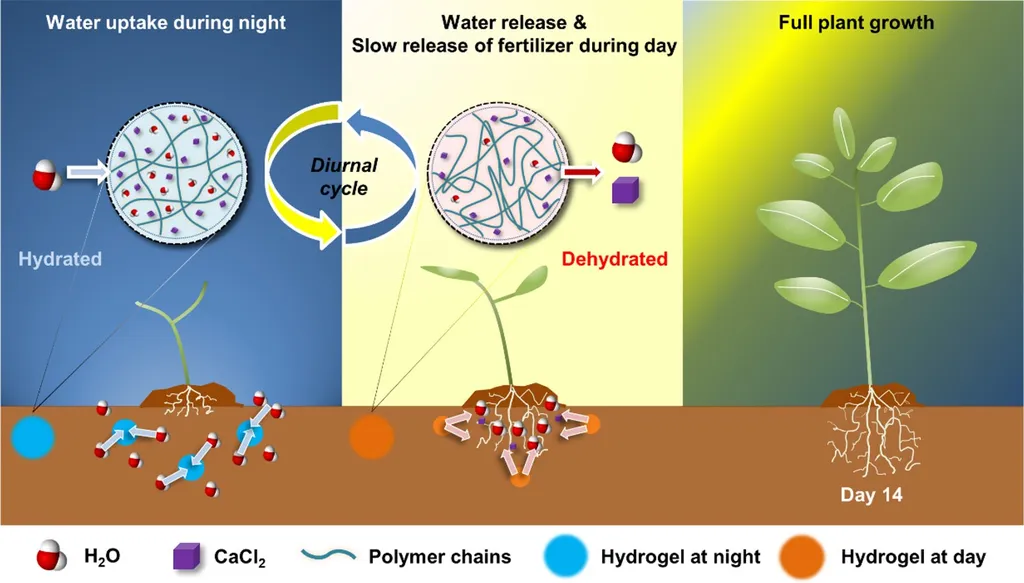
In the heart of Vietnam, researchers have been tinkering with a promising innovation that could revolutionize how we deliver nutrients to crops. A recent study published in the Iranian Journal of Chemistry & Chemical Engineering delves into the synthesis and modification of hydrogels, offering a sustainable solution for nutrient carrier applications in agriculture. The lead author, Huynh Nguyen Anh Tuan from the Faculty of Chemical and Food Technology at Ho Chi Minh City University of Technology and Education, and his team have been exploring the potential of these hydrogels as urea carriers, with intriguing results.
The research focuses on conventional hydrogels (CH) and semi-interpenetrating network hydrogels (SH) derived from N, N’-Dimethylacrylamide (DMA) and Maleic Acid (MA). The team synthesized these hydrogels through free-radical polymerization, varying the monomer ratios and subjecting the SH to post-modifications in strong acid (SA) and strong base (SB) environments. The goal? To understand how these modifications affect the hydrogels’ physicochemical properties and their potential as urea carriers.
The findings are compelling. Scanning electron microscope (SEM) analysis revealed a homogeneous porous structure, with pore sizes varying based on the hydrogel structure and modification environments. “The semi-IPN structure and SB modification significantly improved the swelling properties,” Tuan explains. This is crucial for nutrient absorption and release, as the swelling behavior directly impacts the hydrogel’s capacity to carry and deliver urea.
The study found that the swelling ratios (SR) were 2974.6% for SH, 2508.9% for CH, 2152.4% for SA, and a remarkable 5439.0% for SB. This enhanced swelling in the SB-modified hydrogel translates to a higher urea absorption capacity, with a maximum of 152.9 mg/g. The urea release adhered to the Korsmeyer–Peppas model and exhibited pH-dependent release rates, suggesting a controlled and targeted delivery system.
The practical implications for agriculture are substantial. The Urea/SB hydrogel demonstrated positive support for the growth of mustard greens, highlighting its potential as a nutrient carrier in modern farming techniques. This innovation could lead to more efficient nutrient delivery systems, reducing waste and improving crop yields.
The research also provides valuable insights into the design of hydrogels for nutrient carrier applications. The modifications in strong acid and strong base environments significantly altered the hydrogels’ thermal stability and swelling behavior, offering a blueprint for future developments in the field. As Tuan puts it, “This study offers a sustainable solution aligned with the requirements of modern farming techniques.”
The commercial impact of this research could be profound. With the global agricultural sector increasingly focused on sustainability and efficiency, hydrogels like those developed by Tuan and his team could become a game-changer. The ability to control nutrient delivery not only optimizes plant growth but also minimizes environmental impact, addressing key challenges in modern agriculture.
As we look to the future, the potential applications of these hydrogels extend beyond urea delivery. The principles and methodologies outlined in this study could inspire further innovations in nutrient management, soil health, and precision agriculture. The research published in the Iranian Journal of Chemistry & Chemical Engineering serves as a testament to the power of scientific exploration and its potential to transform industries.
In the words of Huynh Nguyen Anh Tuan, “This study provides valuable insights into the design of hydrogels for nutrient carrier applications, offering a sustainable solution aligned with the requirements of modern farming techniques.” The journey of this innovation from the lab to the field could very well redefine the landscape of agricultural technology.