
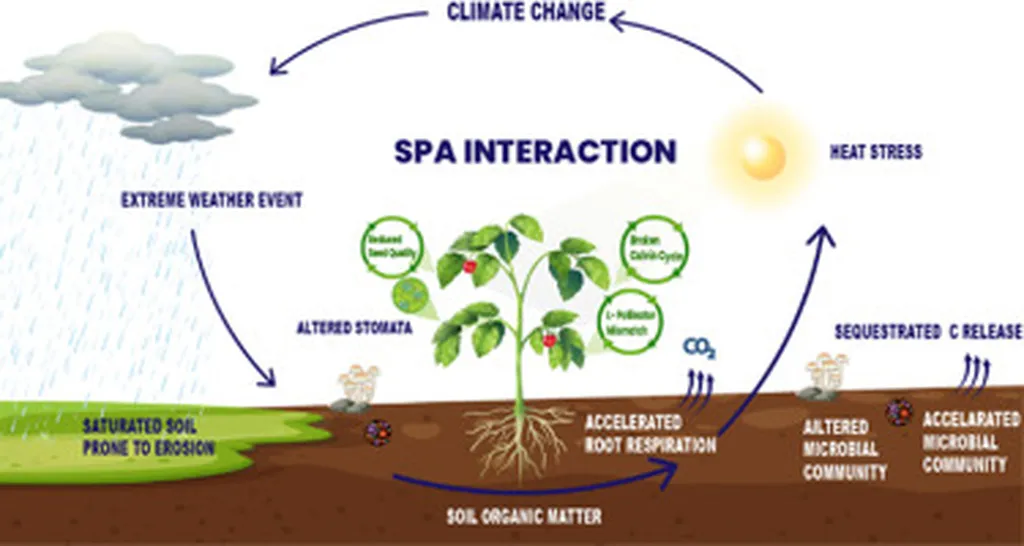
In the face of global warming, understanding the intricate dance between climate and soil organic carbon (SOC) is crucial for predicting and mitigating the impacts on our agricultural systems. A recent study published in *Climate Smart Agriculture* has shed new light on this complex relationship, with significant implications for the agriculture sector.
The research, led by Zhiran Zhou from the College of Geographical and Remote Sciences at Xinjiang University, employed a sophisticated combination of the RothC model and the Random Forest (RF) model to simulate the spatial and temporal distributions of SOC under various warming scenarios. The team constructed six warming scenarios, ranging from 0 to 3 °C, to assess the impact of climate warming on SOC in China.
The results revealed a significant spatial variability in SOC with increasing temperature, characterized by a pattern of “north increasing and south decreasing.” On average, the overall SOC reserves are projected to decrease by about 99.6 Tg, a change expected to be achieved roughly from the mid-to-late 21st century. This decrease follows a non-linear, fluctuating downward trend, highlighting the complexity of SOC dynamics under climate warming.
“The model has high prediction accuracy in the mild warming scenario, but the uncertainty increases in the high temperature scenario,” Zhou explained. This finding underscores the need for more robust models and data to better understand and predict SOC dynamics under extreme climate conditions.
The study also identified vegetation as the dominant factor affecting SOC dynamics, with the highest explanatory power among the variables considered. This insight provides a quantitative basis for improving SOC modeling and understanding the terrestrial carbon cycle under climate warming.
For the agriculture sector, these findings are particularly relevant. SOC plays a critical role in soil health, fertility, and productivity. A decrease in SOC reserves could lead to reduced crop yields and increased vulnerability to climate change for farmers. Moreover, the spatial variability in SOC changes implies that different regions will be affected differently, requiring tailored adaptation strategies.
The research also highlights the importance of integrating multiple models and approaches to better understand and predict the impacts of climate change on agricultural systems. As Zhou noted, “The study reveals the mechanism by which climate factors and vegetation synergistically regulate SOC, which provides a quantitative basis for improving SOC modeling.”
Looking ahead, this research could shape future developments in the field by emphasizing the need for more sophisticated models and data to better understand and predict the impacts of climate change on agricultural systems. It also underscores the importance of considering the spatial variability of SOC changes and the role of vegetation in regulating SOC dynamics.
In conclusion, this study provides valuable insights into the impacts of climate warming on SOC and the potential implications for the agriculture sector. As we continue to grapple with the challenges of climate change, research like this will be crucial in guiding our efforts to build more resilient and sustainable agricultural systems.