
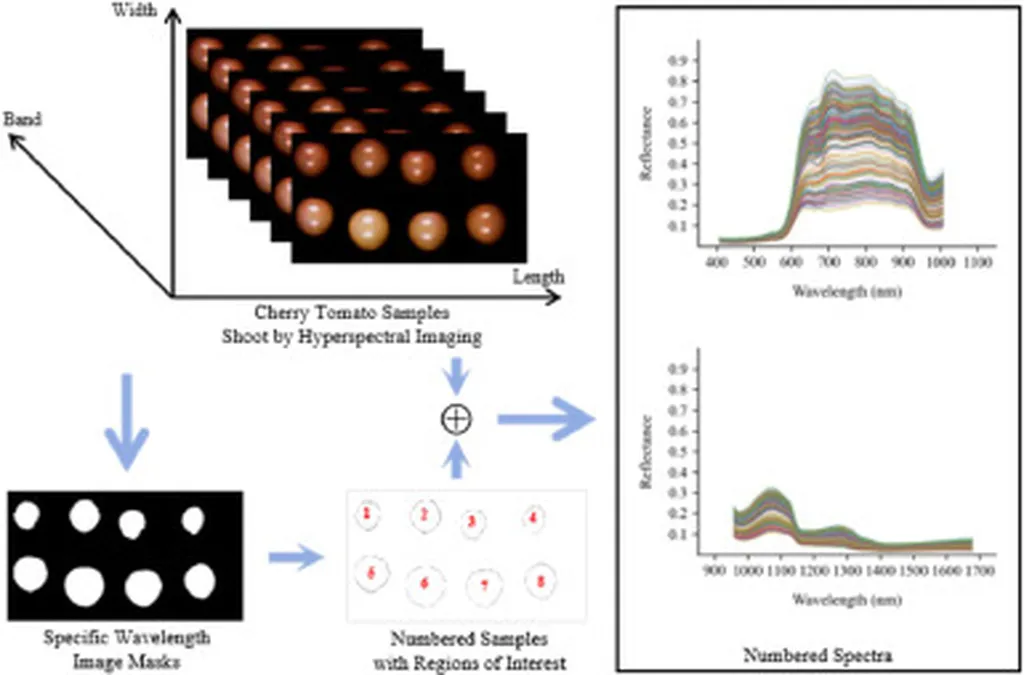
In the ever-evolving landscape of precision agriculture, a groundbreaking study published in *Industrial Crops and Products* is set to revolutionize how we assess and utilize one of the world’s most versatile crops: the tomato. Researchers have developed an innovative, non-destructive framework that combines Low-Rank Adaptation (LoRA) with an Adaptive Spatial Feature Fusion Network (ASFFN) to predict organic acid content in tomatoes using hyperspectral imaging (HSI). This advancement could significantly enhance industrial processing efficiency and economic value extraction from tomato crops.
Organic acids like citric and malic acid are not just essential for human consumption; they are crucial for bio-based chemical synthesis, fermentation, biodegradable plastics, and green solvents. The ability to accurately and rapidly identify tomatoes with high organic acid concentrations could streamline industrial processing, reduce waste, and boost profitability for farmers and processors alike. “This model bridges the gap between agricultural production and industrial application,” says lead author Jiarui Cui, affiliated with the School of Enology and Horticulture at Ningxia University in China. “By enabling precise, non-destructive screening, we’re paving the way for more sustainable and efficient bio-based supply chains.”
The study’s novel approach integrates advanced feature fusion strategies and robust outlier detection, ensuring the model’s generalizability across different tomato varieties. Comparative experiments demonstrated that the proposed LoRA-ASFFN outperformed conventional CNN and PLSR baselines, highlighting its potential for real-world industrial applications. “The model’s accuracy and speed make it a game-changer for quality control in the agriculture sector,” Cui adds. “It allows for rapid decision-making, ensuring that only the highest-quality tomatoes are selected for processing.”
The implications of this research extend beyond the tomato industry. As precision agriculture continues to gain traction, similar models could be adapted for other crops, further optimizing resource use and reducing environmental impact. The study’s findings could also inspire advancements in chemometrics and industrial quality control, fostering a new era of data-driven agriculture.
By leveraging cutting-edge technology, this research not only enhances the economic value of tomato crops but also contributes to the broader goal of sustainable agriculture. As the world increasingly turns to bio-based solutions, the ability to efficiently extract and utilize organic acids from crops like tomatoes will be invaluable. This study, led by Jiarui Cui and published in *Industrial Crops and Products*, marks a significant step forward in this direction, offering a blueprint for future developments in precision agriculture and industrial quality control.