
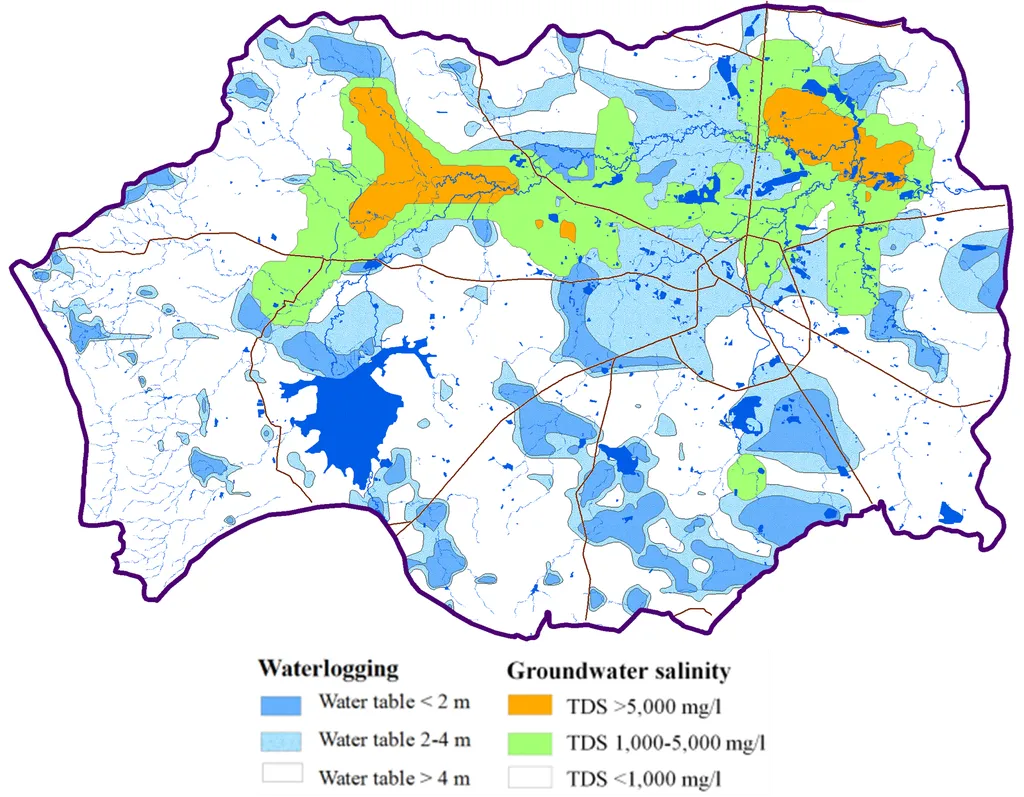
In the heart of Northeastern Thailand, a groundbreaking study is reshaping how we understand and manage salt-affected soils, offering a beacon of hope for sustainable agriculture in the region. Researchers have demonstrated that cokriging spatial interpolation can accurately estimate the electrical conductivity of saturated paste extract (ECₑ) using simpler soil-to-water ratios. This method not only simplifies the process but also significantly reduces costs, making it a game-changer for farmers and land managers.
The study, led by Koddam Rukadi from the Department of Soil Science and Environment at Khon Kaen University, focused on three salt-affected soil classes in Muang Pia Sub-district, Khon Kaen Province. By collecting and analyzing 300 topsoil samples, the team discovered that electrical conductivity measurements at a 1:5 soil-to-water ratio showed the strongest correlation with ECₑ across all soil classes. “The 1:5 ratio consistently provided the highest accuracy, with R² values reaching 0.98 in two soil classes and 0.85 in the third,” Rukadi explained. “This indicates a robust and reliable method for estimating soil salinity.”
The implications for the agriculture sector are profound. Traditional methods of measuring soil salinity can be time-consuming and expensive, often requiring specialized equipment and extensive sampling. The cokriging spatial interpolation technique, however, leverages existing data to create detailed maps of soil salinity, providing farmers with valuable insights without the need for extensive fieldwork. “This approach offers a cost-effective solution for salinity mapping, which is crucial for soil monitoring and land management,” Rukadi added.
The study also revealed that larger sample sizes yielded more consistent results, but even smaller sample sizes maintained acceptable accuracy, particularly for the 1:5 soil-to-water ratio. This flexibility is a significant advantage for farmers operating under limited resources. By adopting this method, they can make informed decisions about soil management, crop selection, and irrigation practices, ultimately enhancing agricultural productivity and sustainability.
The research, published in the ‘Caraka Tani: Journal of Sustainable Agriculture’, highlights the potential of digital soil mapping techniques to revolutionize agriculture. As the global population grows and climate change exacerbates soil degradation, innovative solutions like this are more important than ever. By providing a practical and affordable way to assess soil salinity, this study paves the way for more resilient and productive agricultural systems.
The findings also open new avenues for future research. As digital soil mapping technologies continue to evolve, integrating these methods with other advanced techniques, such as remote sensing and machine learning, could further enhance our understanding of soil health and variability. This holistic approach could lead to even more precise and efficient soil management practices, benefiting farmers and the environment alike.
In the quest for sustainable agriculture, every breakthrough brings us one step closer to a future where food security and environmental stewardship go hand in hand. This study is a testament to the power of innovation and collaboration in addressing some of the most pressing challenges in agriculture today.