
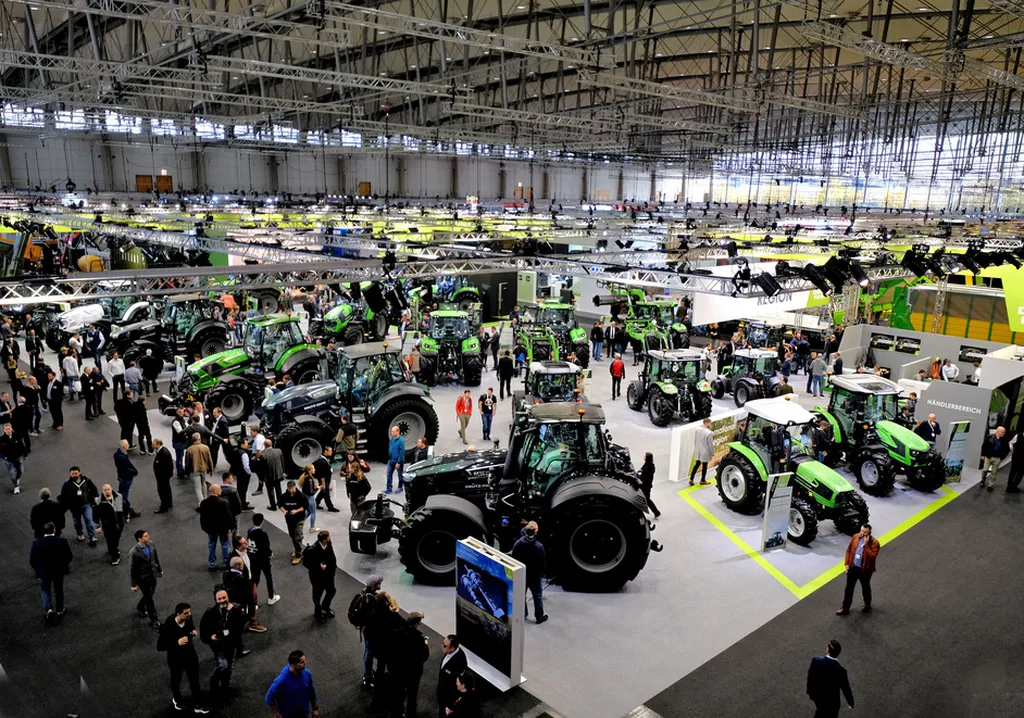
The 2023 Agritechnica trade fair in Hannover showcased a remarkable array of autonomous field robots and applications, marking a significant milestone in the evolution of agritech. In its four-decade history, the event has never witnessed such a diverse and innovative display of autonomous machinery. This year’s exhibition underscored the rapid advancements and growing commercial viability of autonomous solutions in agriculture.
Among the standout debuts was the Fendt Xaver 104 GT, an autonomous implement carrier that harks back to the earlier Fendt GT with its ‘GT’ designation. While the Xaver 104 GT is a concept study, its presence at Agritechnica signals Fendt’s commitment to exploring autonomous technologies. However, the likelihood of this specific model reaching the market in its current form remains uncertain.
In contrast, New Holland’s autonomous R4, a compact machine equipped with tracks from a skid-steer loader, is poised for commercial release. Available in two variants—a battery-electric version with a 40 kWh battery and a hybrid version featuring a 59 hp diesel engine—the R4 is designed for orchards and vineyards. New Holland aims to bring the R4 to market within the next two years, highlighting the accelerating pace of autonomous technology adoption in agriculture.
The Kubota KATR, an all-terrain tractor, made its European debut at Agritechnica. The collaboration between Kubota, AgroIntelli, and the Norwegian company Kilter also brought the Robotti autonomous implement carrier and the Kilter AX-1 spot-spray robot to the Kubota stand. Meanwhile, Kioti showcased the RT100, a prototype of an autonomous electric vehicle designed for transport, weed control, and pest management. The RT100 can navigate autonomously using RTK GPS, follow workers wearing a special vest, or be guided along a line.
One of the more surprising announcements came from machinery manufacturer Kuhn, which revealed it is temporarily pausing the development of its field robot Karl. Despite Karl’s debut two years ago, Kuhn cited uncertainties in the legislation concerning autonomous agricultural vehicles as the reason for the hiatus. The company believes the current legal framework is not clear enough to rule out liability claims, underscoring the challenges that still lie ahead for the widespread adoption of autonomous technologies.
Other notable exhibitors included AgXeed, which introduced the new AgBot T2 7 series equipped with a Deutz 5.1-litre four-cylinder engine. The starting price for this model is €295,000, and the first Dutch buyer has already been secured. Spanish company Zetrack announced a pilot series of 10 battery-electric Zetrabot robots for hire next year, starting at €1,500 per month. The German company Innotrac showcased the Caesar autonomous implement carrier, while Digital Workbench introduced three new series of autonomous implement carriers: the Tipard 500, 1500, and 2500.
The Italian manufacturer Agricobots presented the Automatica field robot, powered by a 75 hp Perkins diesel engine. The Czech company Terms unveiled a prototype of the battery-electric Roboton field robot, and LJ Tech from China brought two autonomous hybrid spraying robots to Hannover: the S500 Pro and the S1000. Fravebot from the Czech Republic showcased the autonomous Scout, which follows pipe rails in greenhouses and scans crops for pest detection and yield forecasting.
The implications of these advancements are profound. As autonomous technologies become more sophisticated and commercially viable, they promise to enhance efficiency, reduce labor costs, and improve sustainability in agriculture. However, the challenges highlighted by Kuhn regarding legal and regulatory frameworks must be addressed to ensure the smooth integration of these technologies into the agricultural landscape. The 2023 Agritechnica trade fair has set a new benchmark for autonomous agritech, and the coming years will be crucial in determining how these innovations shape the future of farming.