
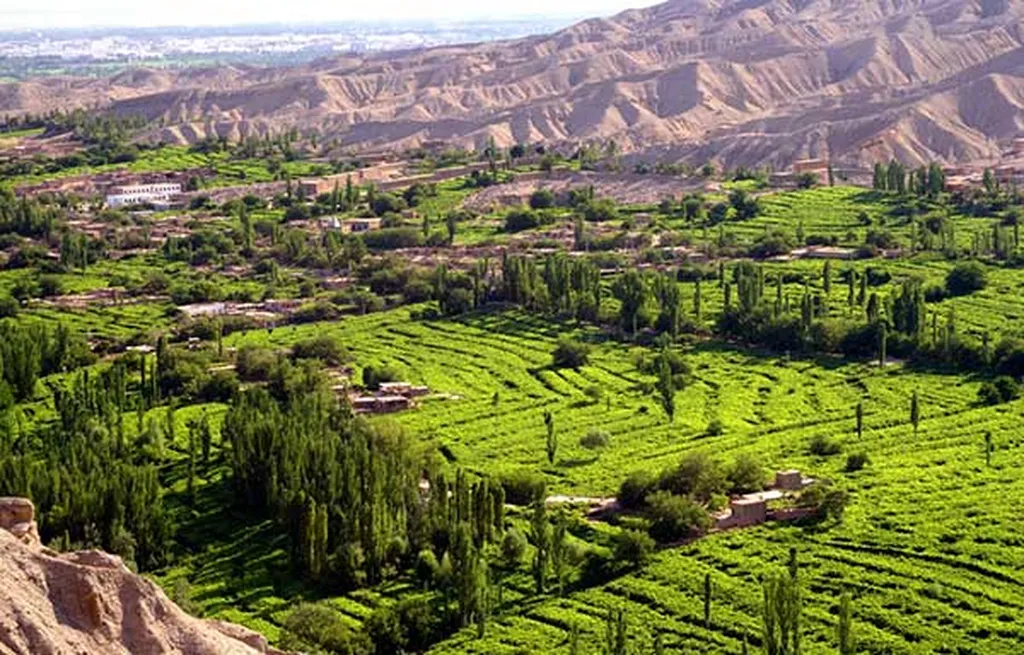
In the heart of China’s arid northwest, the Turpan-Hami Basin, known as the “Land of Fruits and Melons,” is undergoing a significant transformation in its agricultural landscape. A recent study published in *Smart Agricultural Technology* has shed light on the spatiotemporal changes in the region’s cropping structure, offering valuable insights for the agriculture sector.
The research, led by Xuemei Han from the Key Laboratory of Digital Earth Science at the Chinese Academy of Sciences, utilized long-term Landsat imagery and crop phenological information to develop a novel method for monitoring agricultural changes. The Temporal Extreme-Value and Visual Separation (EVS) method, combined with a random forest-based crop identification model, achieved impressive accuracies exceeding 85% and Kappa coefficients above 0.79.
From 1990 to 2023, the agricultural planting area in the Turpan-Hami Basin expanded from 104.95 × 10³ hectares to 191.90 × 10³ hectares. “This expansion is not just about the size of the agricultural area,” Han explains. “It’s about the shift in the cropping structure, moving away from traditional grain crops towards high-value economic crops like melons, grapes, and cotton.”
This shift has significant commercial implications. The increased focus on high-value crops can potentially boost the region’s economic output and improve the livelihoods of local farmers. “The transformation in cropping structure is a response to market demands and technological advancements,” says Han. “It’s a strategic shift that can enhance the region’s competitiveness in the agricultural market.”
The study’s findings provide a robust data foundation for the scientific management and optimization of cropping structures in arid oasis agricultural systems. This research could shape future developments in the field by offering a methodological reference for other arid regions facing similar challenges.
As the agriculture sector continues to evolve, the integration of remote sensing technology and advanced data analysis methods will play a crucial role in shaping sustainable and profitable agricultural practices. The Turpan-Hami Basin serves as a compelling case study, demonstrating the potential of these technologies to drive positive change in the agriculture sector.
The research led by Xuemei Han, affiliated with the Key Laboratory of Digital Earth Science, Aerospace Information Research Institute, Chinese Academy of Sciences, and the International Research Center of Big Data for Sustainable Development Goals, highlights the importance of adapting to market demands and leveraging technology to optimize agricultural practices. This study not only provides valuable insights for the Turpan-Hami Basin but also offers a blueprint for other regions looking to enhance their agricultural productivity and sustainability.