
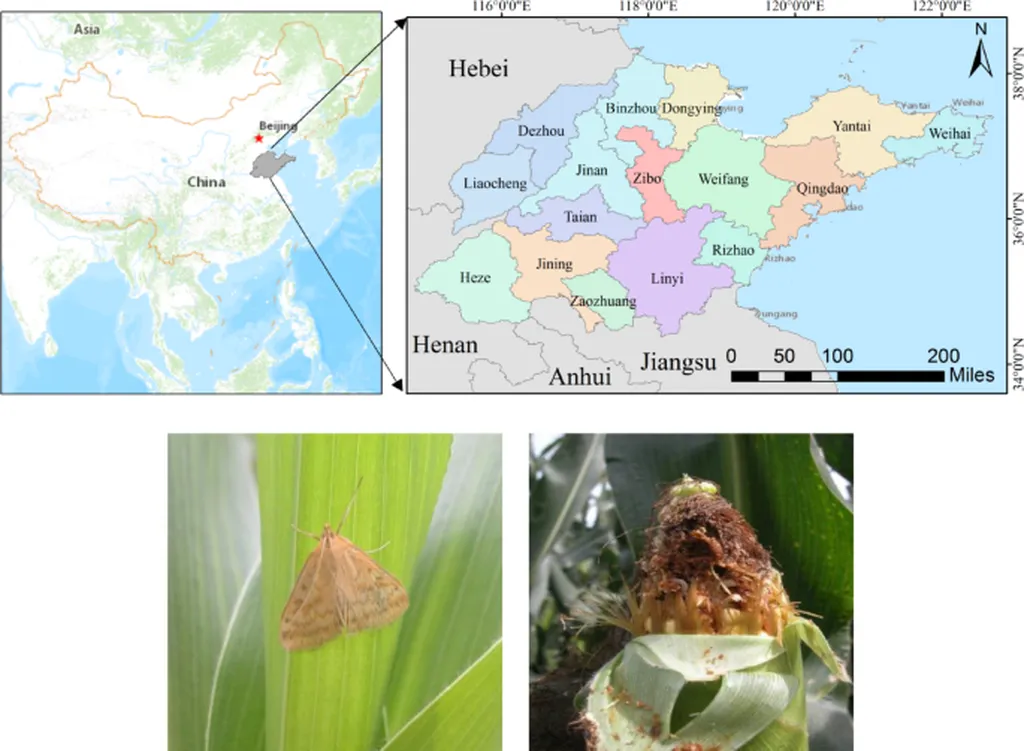
In the heart of China’s vast cornfields, a tiny yet formidable foe lurks: the corn borer. This pest has long been a bane to farmers, chipping away at yields and quality. But a new study published in *Smart Agricultural Technology* offers a glimmer of hope, armed with the latest in artificial intelligence and computer vision.
The research, led by Dequan Guo from the School of Automation at Chengdu University of Information Technology, introduces a novel method for identifying corn borer larvae in the field. The method, dubbed RIoUBCELoss, combines multi-resolution representation and a unique loss function to tackle the challenges posed by complex farmland backgrounds and the varying sizes and morphologies of the larvae.
“Accurate identification of corn borer larvae is crucial for ensuring corn yield and quality,” Guo explains. “Our method effectively reduces the interference of complex backgrounds and improves the learning ability of the model to larval features.”
The implications for the agriculture sector are substantial. Precision in pest identification can lead to targeted, efficient pest control, reducing the need for broad-spectrum pesticides. This not only cuts costs for farmers but also promotes more sustainable farming practices.
The study reports impressive results, with the proposed method achieving an Intersection over Union (IoU) of 82.22% and a Dice score of 89.06% on a field corn borer larvae image dataset. Compared to the second-best model, U-Net++, the improvements are notable, with IoU and Dice scores seeing increases of 4.34% and 3.27%, respectively.
But the benefits extend beyond immediate improvements in identification accuracy. This research could pave the way for future developments in agricultural technology, inspiring innovations in automated pest control systems and integrated pest management strategies.
As the agriculture sector continues to embrace technology, studies like this one serve as a testament to the power of AI and computer vision in addressing real-world challenges. With further research and development, these technologies could revolutionize farming practices, ensuring food security and sustainability for generations to come.
In a rapidly evolving technological landscape, Guo’s work stands as a beacon of progress, illuminating the path towards smarter, more efficient, and more sustainable agriculture.