
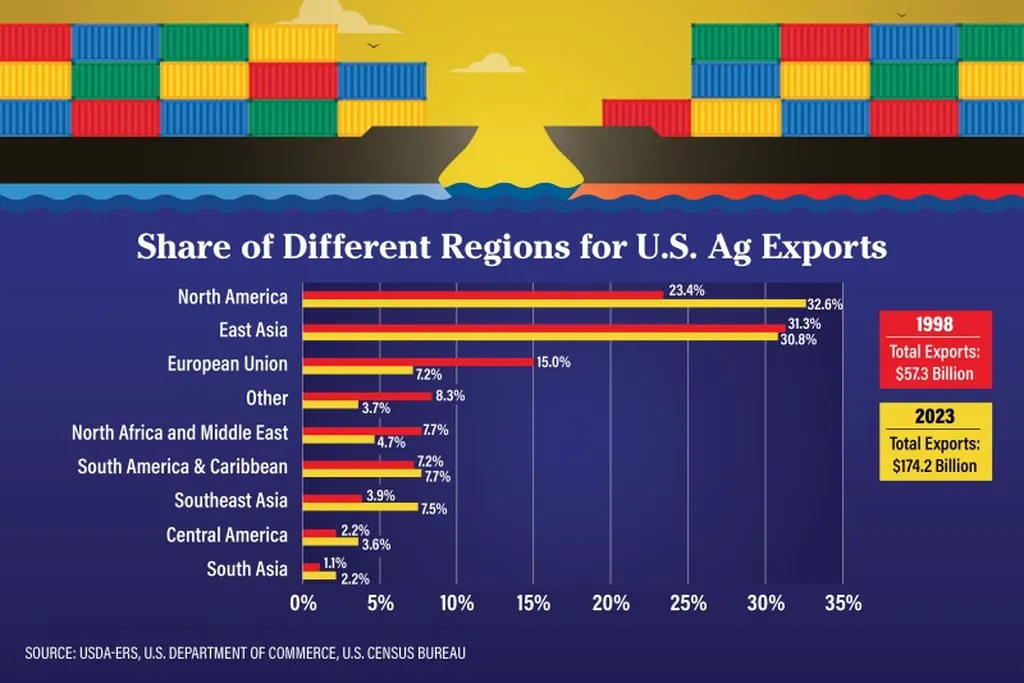
In a series of strategic moves aimed at bolstering U.S. agricultural exports, President Trump’s administration has unveiled several trade agreements following his recent Asia trip, adding to earlier deals with the United Kingdom and the European Union. These agreements, while promising, are still in their preliminary stages and carry an air of uncertainty, both in their final form and their path to implementation.
The most significant development came after President Trump’s meeting with Chinese President Xi Jinping in South Korea. The White House announced a “historic agreement” that promises to open China’s market to U.S. soybeans and other agricultural exports. The deal includes the suspension of China’s retaliatory tariffs on a range of U.S. agricultural products, including chicken, wheat, corn, cotton, sorghum, soybeans, pork, beef, aquatic products, fruits, vegetables, and dairy products. Notably, China has committed to purchasing at least 12 million metric tons of U.S. soybeans in the final two months of 2025 and at least 25 million metric tons annually from 2026 to 2028. The U.S. Department of Agriculture (USDA) has reported that since the summit, China has already purchased 792,000 metric tons of U.S. soybeans. However, it’s important to note that China has not publicly confirmed its commitment to these soybean purchases, and a 13% tariff on imported U.S. soybeans remains in place.
In Japan, President Trump met with Prime Minister Sanae Takaichi to reconfirm a Framework Agreement aimed at boosting agricultural trade. The agreement includes a 75% increase in U.S. rice procurements within Japan’s Minimum Access rice scheme and an $8 billion annual investment in U.S. agricultural goods, including corn, soybeans, fertilizer, and bioethanol. Japan has reconfirmed these commitments in a joint statement with the U.S.
Turning to Europe, the U.S. and the U.K. announced the U.S.-UK Economic Prosperity Deal in May 2025. This agreement includes the removal of a 20% tariff on U.S. beef exports within a quota of 1,000 metric tons and the creation of a preferential duty-free quota of 13,000 metric tons for U.S. beef. The deal also commits both nations to improving market access for agricultural products. Similarly, the U.S. and the E.U. announced a Framework Agreement in July 2025, which provides preferential market access for a range of U.S. agricultural goods and commits both parties to addressing non-tariff barriers affecting trade.
In Southeast Asia, the U.S. and Malaysia executed the “Agreement on Reciprocal Trade,” which includes significant preferential market access for U.S. agricultural products and commitments to address non-tariff barriers. On the same day, a new trade agreement with Cambodia was announced, eliminating tariffs on all U.S. food and agricultural product imports and promoting the importation of U.S. agricultural products.
However, the path to implementation of these agreements is not without hurdles. The most recent Trade Promotion Authority (TPA) expired in 2021, creating uncertainty about whether these agreements will require congressional approval. This, combined with the preliminary nature of these agreements, means that their final form and impact on U.S. agricultural exports remain to be seen. Nevertheless, these developments mark a significant step in the Trump administration’s efforts to expand U.S. agricultural trade and could potentially bring substantial benefits to American farmers and the economy.