
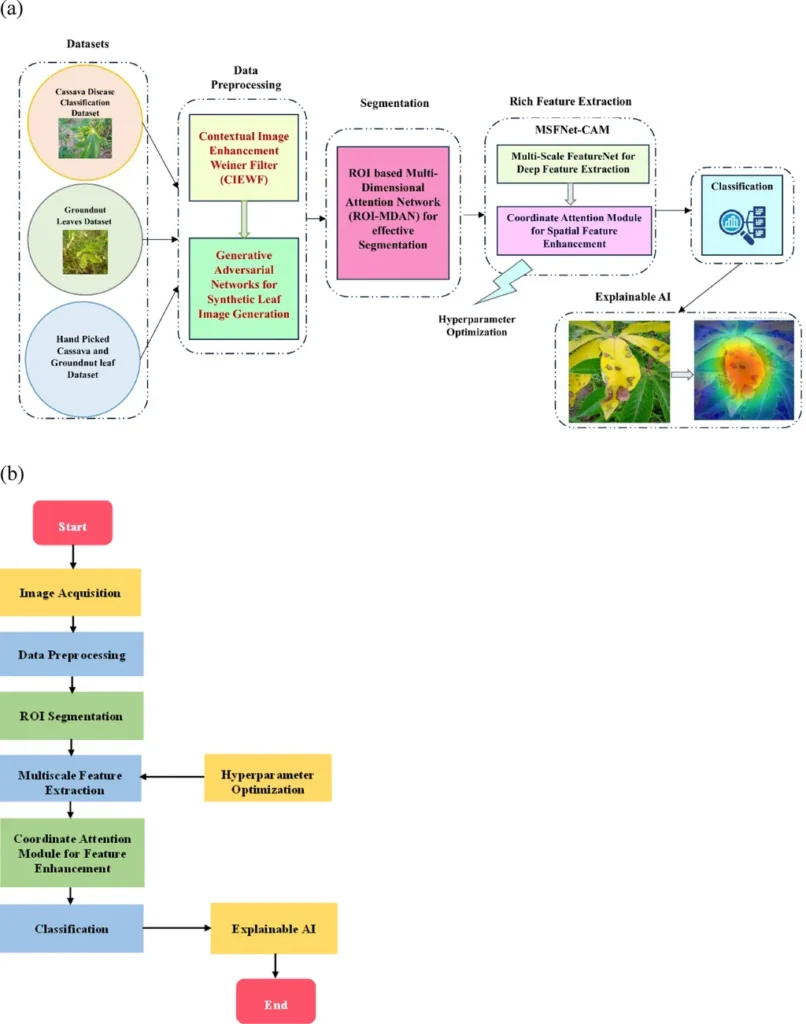
In the quest to bolster agricultural productivity and ensure crop health, researchers have developed a cutting-edge deep learning framework that promises to revolutionize the way leaf diseases are diagnosed. This advanced system, detailed in a recent study published in *Scientific Reports*, combines a suite of innovative techniques to enhance the accuracy of disease detection in cassava and groundnut plants.
The framework begins with the collection of real-time leaf images from diverse agricultural environments, capturing a wide array of conditions that leaves might encounter. To ensure high-quality images and precise segmentation, the researchers employed the Contextual Image Enhancement Wiener Filter (CIEWF). This filter effectively reduces noise, setting the stage for more accurate analysis. “By improving image quality, we can significantly enhance the model’s ability to detect and classify diseases,” explained lead author R. Sudhakar from the Department of Computer Science and Engineering at Nandha College of Technology.
Data augmentation is another critical component of the framework. Using a Generative Adversarial Network (GAN), the researchers increased the diversity of their dataset, which in turn improved the model’s generalization capabilities. This means the model can better adapt to new, unseen data, making it more reliable in real-world applications.
One of the most innovative aspects of this research is the development of a novel Region of Interest-based Multi-Dimensional Attention Network (ROI-MDAN). This network identifies and segments critical disease-affected areas within the leaves, allowing for more targeted and accurate diagnosis. “The ROI-MDAN focuses on the most relevant parts of the leaf, which helps in pinpointing the exact areas affected by disease,” Sudhakar noted.
For robust feature extraction, the researchers proposed the MSFNet-CAM model. This model leverages parallel multi-scale features and incorporates Coordinate Attention to enhance feature fusion and improve classification performance. The result is a more accurate and reliable diagnosis of leaf diseases.
To ensure transparency and interpretability, the researchers used Gradient-weighted Class Activation Mapping (Grad-CAM). This technique highlights the influential regions contributing to disease classification, making the model’s decision-making process more understandable. “Grad-CAM provides a visual explanation of the model’s decisions, which is crucial for gaining the trust of farmers and agricultural experts,” Sudhakar added.
The commercial implications of this research are substantial. Accurate and timely diagnosis of leaf diseases can lead to early intervention, reducing crop losses and increasing yields. This can have a profound impact on the agricultural sector, particularly in regions where cassava and groundnut are staple crops. The framework’s ability to adapt to diverse environmental conditions makes it a versatile tool for farmers worldwide.
Looking ahead, this research sets a new benchmark for AI-assisted plant disease diagnosis. The integration of advanced deep learning techniques with explainable AI paves the way for more sophisticated and reliable diagnostic tools. As the technology continues to evolve, we can expect even more innovative solutions that will further enhance agricultural productivity and sustainability.
In the words of Sudhakar, “This research is just the beginning. The potential for AI in agriculture is vast, and we are excited to explore new frontiers in this field.” With continued advancements, the future of agricultural diagnostics looks brighter than ever.