
In a significant stride towards sustainable agriculture, researchers have uncovered the potential of combining cover crops with biofertilizers to enhance the growth and quality of Apium graveolens, a plant often hindered by continuous cropping obstacles. The study, published in *Industrial Crops and Products*, offers promising insights for farmers and agronomists seeking to optimize crop yields while maintaining soil health.
The research, led by Jiawen Wu from the College of Horticulture and Landscape Architecture at Northeast Agricultural University in Harbin, China, explored the synergistic effects of mixed cover crops (Triticum aestivum and Vicia sativa) and various biofertilizers on Apium graveolens. The findings suggest that the combination of cover crops with bacterial fertilizers or vermicompost can significantly improve plant growth and soil chemistry.
“Our study demonstrates that the integration of cover crops with biofertilizers not only enhances the productivity of Apium graveolens but also fosters a healthier soil ecosystem,” said Wu. “This approach could revolutionize sustainable agriculture by providing a robust strategy for continuous cropping systems.”
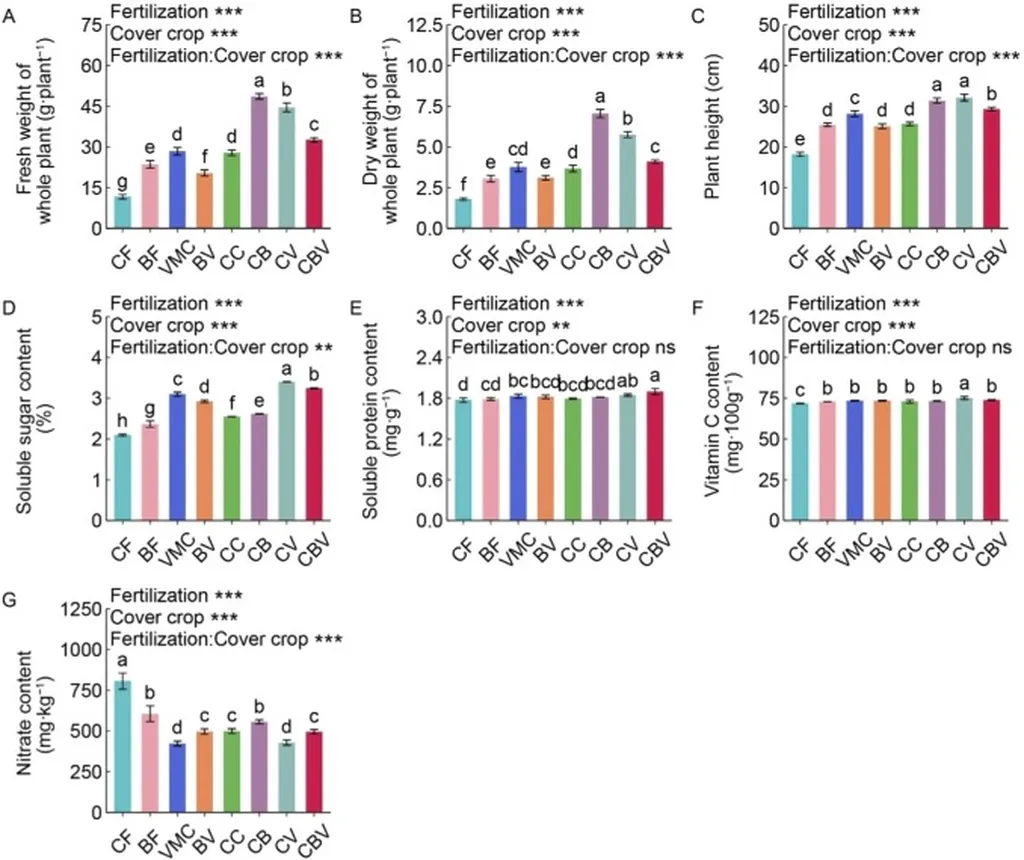
The experiment involved eight different treatments, including chemical fertilizers, bacterial fertilizers, vermicompost, and their combinations with cover crops. The results showed that the treatments combining cover crops with bacterial fertilizers (CB) and vermicompost (CV) were particularly effective. CB treatment led to the highest growth rates, while CV treatment resulted in the best quality outcomes for Apium graveolens.
One of the most intriguing findings was the impact of these treatments on rhizosphere bacterial communities. The study revealed that cover crops enriched specific beneficial bacteria, such as Bacillus spp., while combinations with biofertilizers promoted the growth of Pseudomonas spp. This alteration in bacterial communities was closely linked to changes in soil chemical properties, such as pH and electrical conductivity (EC).
“Understanding how these treatments influence soil chemistry and microbial communities is crucial for developing targeted strategies to improve crop productivity and sustainability,” explained Wu. “Our research highlights the importance of a holistic approach that considers both the plant and its soil environment.”
The commercial implications of this research are substantial. Farmers can potentially reduce their reliance on chemical fertilizers by adopting these integrated approaches, leading to cost savings and environmental benefits. Additionally, the improved soil health and microbial diversity can enhance the resilience of crops to environmental stresses, ensuring more stable yields over time.
As the agriculture sector continues to seek sustainable solutions, this study provides a compelling case for the adoption of cover crops and biofertilizers. The findings not only offer practical insights for current farming practices but also pave the way for future research into the complex interactions between plants, soil, and microorganisms.
“By leveraging the natural synergies between cover crops and biofertilizers, we can create more sustainable and productive agricultural systems,” Wu concluded. “This research is a stepping stone towards a more resilient and eco-friendly future for agriculture.”
With the growing demand for sustainable practices, the integration of cover crops and biofertilizers could become a cornerstone of modern agriculture, benefiting both farmers and the environment.