
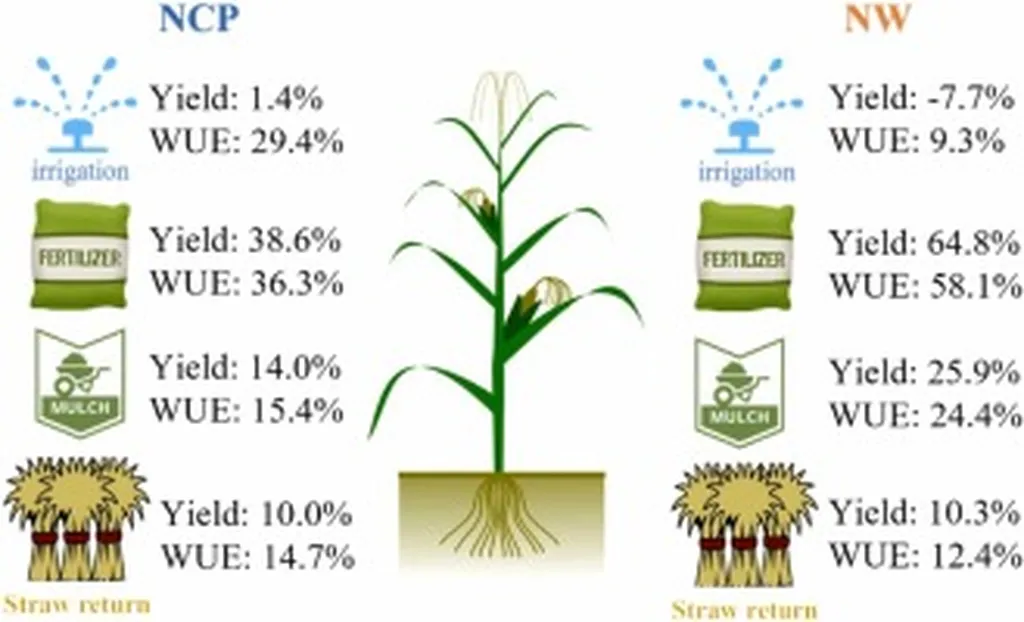
In the heart of the North China Plain, a region where the delicate balance between water scarcity and food demand is a constant challenge, researchers have been exploring innovative strategies to optimize water use and boost crop yields. A recent study published in *Agricultural Water Management* sheds light on the intricate dynamics of deficit irrigation combined with various mulching techniques, offering promising insights for the agriculture sector.
The research, led by Shanshan Qin from the College of Agricultural Science and Engineering at Hohai University and the China Institute of Water Resources and Hydropower Research, delves into the effects of different irrigation amounts and mulching measures on the winter wheat-summer maize rotation system. This system is pivotal for food security in the region, making the findings particularly relevant for farmers and policymakers alike.
Deficit irrigation, a practice that deliberately applies less water than the crop would typically need, has been a topic of interest due to its potential to save water. However, the impact of this practice on subsequent crops has been less understood. The study revealed that while deficit irrigation during the winter wheat season reduced soil water content, leaf area index, and aboveground biomass, leading to a decrease in thousand-grain weight and yield, these effects did not carry over to the subsequent maize crop.
“Our findings suggest that deficit irrigation during wheat season does not necessarily compromise the yield of the following maize crop,” Qin explained. “This is a crucial insight as it allows farmers to adopt water-saving practices without fearing long-term yield penalties.”
The study also explored the role of mulching materials, comparing no mulching, transparent film, black film, and straw mulching under both full and deficit irrigation conditions. Transparent film mulching under deficit irrigation emerged as the most effective strategy, significantly increasing the annual yield and profit of the wheat-maize rotation. However, the use of black film and straw mulching did not yield similar benefits due to a notable decrease in the thousand-grain weight of wheat.
“Transparent film mulching shows great promise for water-saving and yield-increasing strategies,” Qin noted. “However, its widespread application must consider the environmental impact, particularly the management of film residue. Biodegradable alternatives could be a viable solution.”
The commercial implications of these findings are substantial. Farmers in the North China Plain and similar regions can adopt deficit irrigation and transparent film mulching to enhance water productivity and profitability. The study underscores the importance of tailored water management strategies that balance immediate water savings with long-term sustainability.
As the agriculture sector grapples with the challenges of climate change and resource scarcity, research like this provides a roadmap for innovative and sustainable practices. The insights from Qin’s study could shape future developments in agritech, encouraging the adoption of water-saving technologies and practices that ensure food security without compromising environmental health.
For the agriculture sector, the message is clear: by embracing deficit irrigation and transparent film mulching, farmers can navigate the delicate balance between water conservation and productivity, securing a more sustainable future for all.