
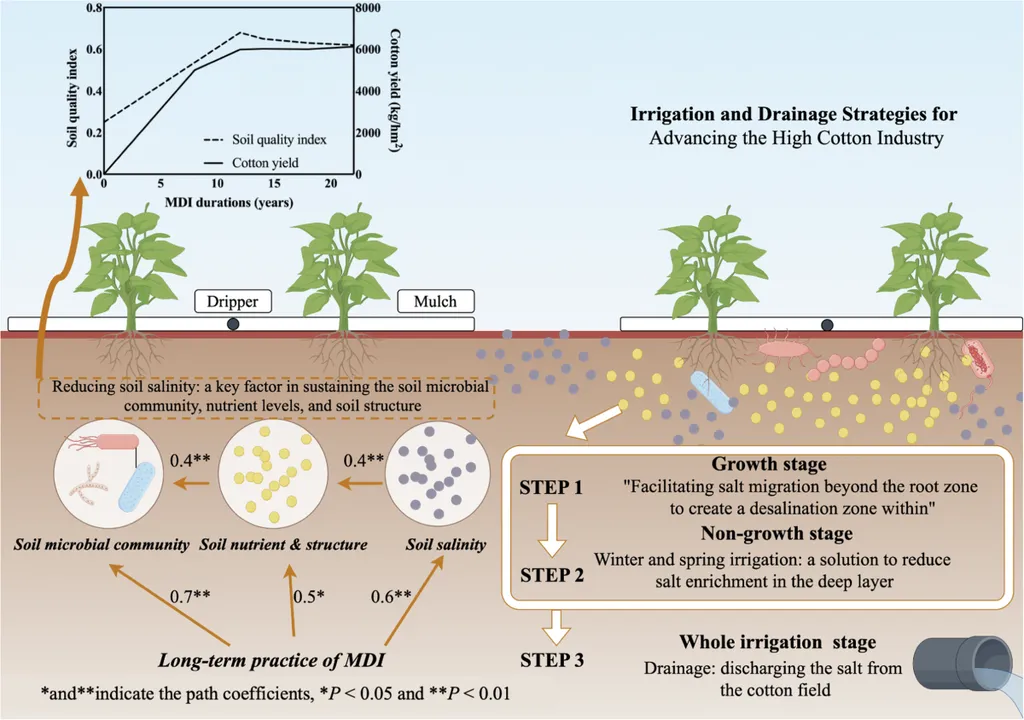
In the heart of Xinjiang’s arid landscapes, a groundbreaking study is reshaping the future of cotton farming, offering a beacon of hope for sustainable agriculture in the face of water scarcity and soil degradation. Researchers, led by Jianshu Dong from the College of Water Conservancy Engineering at Tianjin Agricultural University and the College of Water Conservancy & Architectural Engineering at Shihezi University, have unveiled a novel approach to optimize water and nitrogen management in cotton cultivation, with profound implications for the agriculture sector.
The study, published in *Industrial Crops and Products*, presents a two-year field experiment conducted in Alaer, Xinjiang, where cotton plants were subjected to varying levels of irrigation and nitrogen fertilization under mulching and drip irrigation. The results are nothing short of transformative. By employing a combination of 390 mm of irrigation and 390 kg/ha of nitrogen, the researchers achieved a remarkable seed cotton yield of approximately 7549 kg/ha. This optimized strategy not only enhances productivity but also significantly improves water and nitrogen use efficiency, addressing critical environmental challenges.
“Our findings demonstrate that by carefully managing water and nitrogen inputs, we can achieve a delicate balance between maximizing cotton yield and minimizing resource waste,” said lead author Jianshu Dong. “This approach is particularly crucial in arid regions like southern Xinjiang, where water scarcity and soil degradation pose significant threats to sustainable agriculture.”
The study’s innovative use of the DSSAT-CROPGRO-Cotton model further underscores its scientific rigor and practical applicability. The model’s high accuracy in predicting yield and nitrogen partial factor productivity provides farmers with a powerful tool for decision-making. “The DSSAT model’s precision in predicting outcomes allows farmers to make informed decisions, ultimately leading to more efficient and sustainable agricultural practices,” Dong explained.
The commercial impacts of this research are substantial. By adopting the optimized water-nitrogen synergistic management strategy, cotton farmers can expect to see a significant boost in productivity while reducing their environmental footprint. This is particularly relevant in the context of global water scarcity and the increasing demand for sustainable agricultural practices. The study’s findings offer a blueprint for enhancing resource use efficiency, which is crucial for the long-term viability of the agriculture sector.
Moreover, the research highlights the importance of multiobjective optimization in agricultural management. While the W1N3 treatment achieved the highest partial factor productivity of nitrogen, it resulted in suboptimal cotton yield and water productivity. This underscores the need for a balanced approach that considers both resource efficiency and productivity.
As the agriculture sector grapples with the challenges of climate change and resource depletion, this study provides a scientific basis for efficient water and nitrogen management in cotton cultivation. The findings not only offer immediate practical benefits but also pave the way for future developments in precision agriculture and sustainable farming practices.
In the words of Jianshu Dong, “This research is a stepping stone towards a more sustainable and productive future for cotton farming. By leveraging advanced modeling techniques and optimized management strategies, we can address the pressing environmental challenges and meet the growing demands of the agriculture sector.”
As the world looks towards sustainable solutions to feed its growing population, this study stands as a testament to the power of scientific innovation in shaping the future of agriculture.