
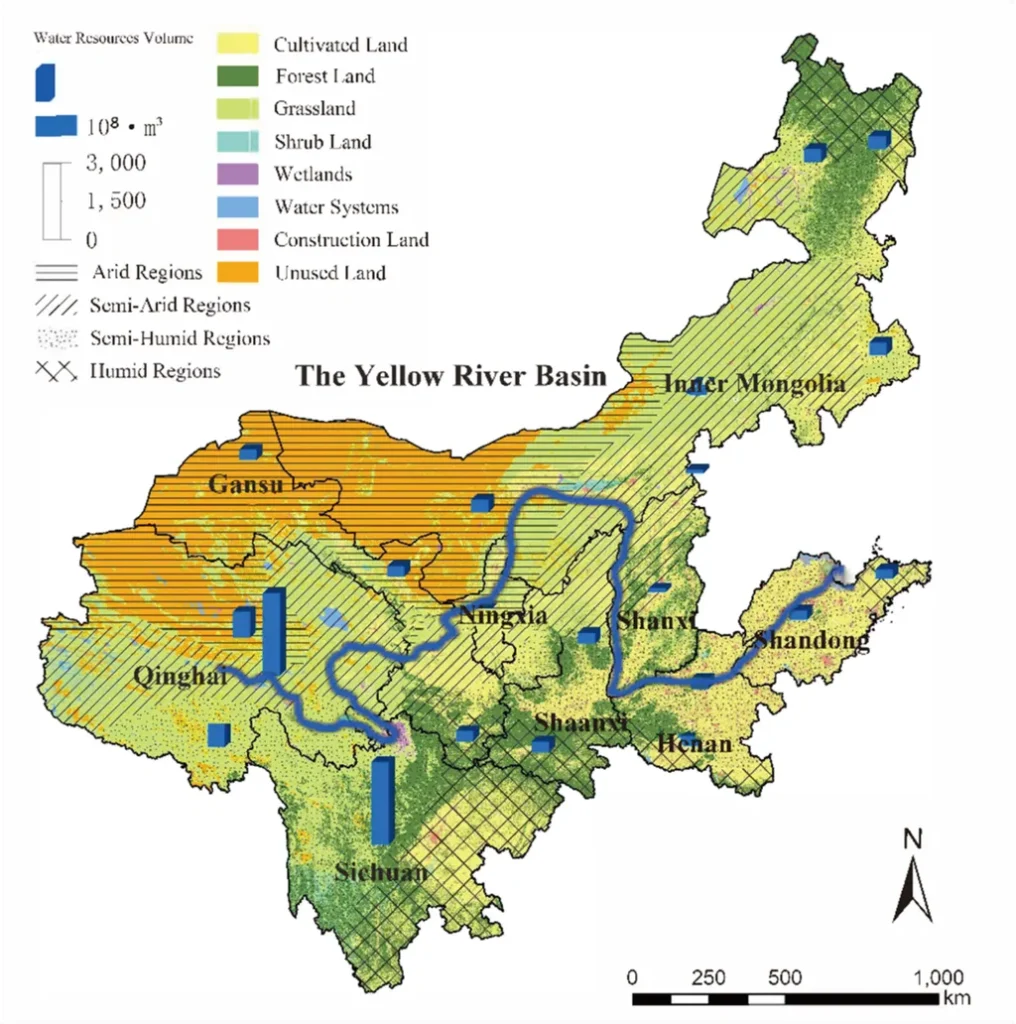
In the heart of China’s agricultural landscape, the Yellow River Basin, a significant shift is underway, one that could redefine the future of arable land use and sustainable agriculture. A recent study published in *Frontiers in Sustainable Food Systems* has shed light on the spatiotemporal dynamics and influencing factors of the green transformation of arable land use (GTALU) in this critical region. The research, led by Mengge Wang from the School of Geographic Sciences at Henan University, offers valuable insights that could shape the trajectory of the agriculture sector.
The study, which spans from 2005 to 2022, reveals that GTALU in the Yellow River Basin has followed an ‘N’-shaped characteristic, indicating a dynamic yet stable pattern of transformation. This finding is crucial for stakeholders in the agriculture sector, as it underscores the need for adaptive and flexible strategies that can navigate the evolving landscape of arable land use.
One of the most compelling aspects of the research is its identification of the main influencing factors of GTALU. According to the study, factors such as Digital Elevation Model (DEM), Slope (SP), Arable Land Ratio (ALR), Population Density (PD), and Industrialization Index (II) play significant roles. Notably, the Industrialization Index emerged as a dominant factor, highlighting the profound impact of industrial activities on agricultural practices.
“The comprehensive effect of main factors showed significant spatial non-stationarity characteristics,” Wang explained. This means that the influence of these factors varies across different regions, necessitating tailored approaches to GTALU. For instance, while II and SP have significant positive impacts in Shandong province and the southwest of the research area, DEM, ALR, and PD have significant negative impacts in other regions.
The implications of these findings for the agriculture sector are substantial. By understanding the spatiotemporal patterns and influencing factors of GTALU, agricultural businesses can make more informed decisions about land use, resource allocation, and sustainable practices. This knowledge can also guide policymakers in formulating differentiated GTALU development strategies that align with local conditions, ultimately promoting high-quality agricultural development and ecological protection.
Moreover, the study’s innovative use of exploratory spatiotemporal data analysis (ESTDA) methods and the ‘individual-interaction-comprehensive’ analytical framework sets a new standard for research in this field. The combination of the optimal parameter geographical detector (OPGD) and geographically weighted regression-improved structural equation model (GWR-SEM) models provides a robust toolkit for analyzing the complex interplay of factors influencing GTALU.
As the agriculture sector continues to grapple with the challenges of resource constraints and sustainability, the insights from this research offer a beacon of hope. By embracing the findings and adopting a more nuanced, data-driven approach to arable land use, the sector can break free from resource constraints and achieve sustainable agriculture.
In the words of Wang, “This research provides scientific support for formulating differentiated GTALU development strategies according to local conditions.” This support is not just scientific but also commercially impactful, paving the way for a greener, more sustainable future for agriculture in the Yellow River Basin and beyond.