
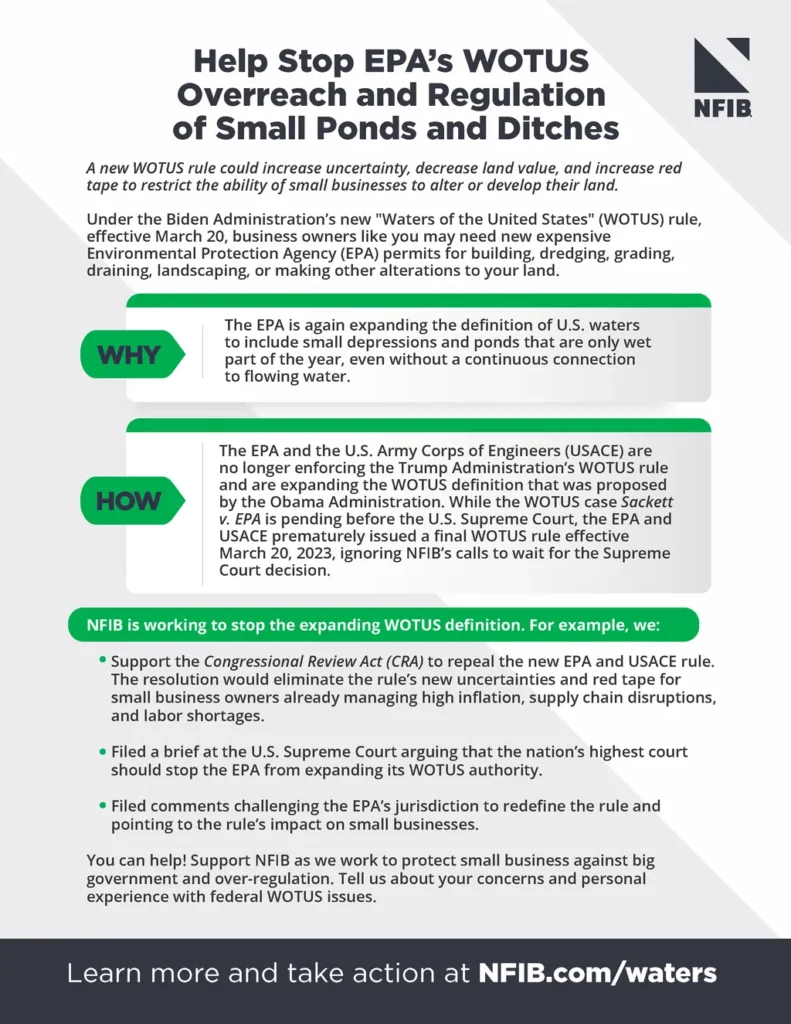
On November 17, 2025, the Environmental Protection Agency (EPA) and the United States Army Corps of Engineers (the Corps) unveiled a proposed rule to redefine “waters of the United States” (WOTUS) under the Clean Water Act (CWA). This proposal aims to align the definition with the Supreme Court’s 2023 decision in Sackett v. EPA, marking the sixth change to the WOTUS definition since 2015. The proposal is now open for public comment until January 5, 2026.
The CWA, enacted in 1972, is a cornerstone of U.S. water pollution regulation. It aims to restore and maintain the integrity of the nation’s waters through permitting programs that limit pollution discharge. The National Pollution Discharge Elimination System (NPDES) and the 404 permitting program regulate discharges into “navigable waters,” defined as “waters of the United States.” However, the CWA leaves the definition of WOTUS to the EPA and the Corps, leading to decades of regulatory and legal debate.
The most recent WOTUS definition, finalized in 2023, included five categories of waters and incorporated both the “relatively permanent standard” and the “significant nexus test” from the Supreme Court’s 2006 Rapanos v. US decision. The relatively permanent standard extends WOTUS to waters that are continuously flowing or standing, while the significant nexus test includes wetlands that significantly affect the integrity of recognized WOTUS.
However, the Supreme Court’s 2023 Sackett v. EPA decision overturned the significant nexus test, limiting WOTUS to relatively permanent waters and wetlands with a continuous surface connection. In response, the EPA issued the Conforming Rule in August 2025, which removed references to the significant nexus test and clarified the definition of “adjacent” wetlands.
The latest proposal seeks to further refine the WOTUS definition, aiming to provide clarity to landowners and the public. It proposes five categories of WOTUS:
1. Traditionally navigable waters, including tidal waters and the territorial seas.
2. Impoundments of waters otherwise identified as WOTUS.
3. Tributaries of traditionally navigable waters that are relatively permanent.
4. Wetlands adjacent to traditionally navigable waters or tributaries.
5. Lakes and ponds that are relatively permanent, continuously flowing, and share a continuous surface connection with a traditionally navigable water or tributary.
Notably, the proposal excludes interstate waters from the WOTUS definition, a departure from previous definitions. It also specifies that waters in category five must meet both the relatively permanent standard and the continuous surface connection requirement.
The proposal is expected to face legal challenges once finalized, continuing the long-standing debate over the scope of federal jurisdiction under the CWA. Stakeholders, including landowners, environmental groups, and industry representatives, are encouraged to review the proposal and submit comments during the public comment period. The EPA and the Corps will consider these comments before finalizing the rule.
As the regulatory landscape continues to evolve, the agricultural community and other affected industries must stay informed and engaged in the process. The outcome of this rulemaking will have significant implications for water quality regulation and permitting requirements across the United States.