
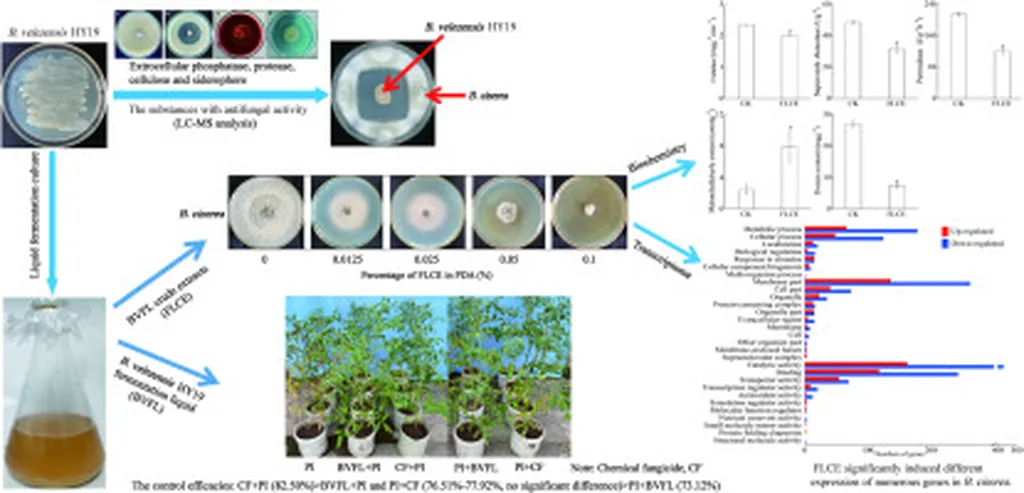
In the quest to reduce post-harvest losses and minimize the use of chemical fungicides, a promising study published in *Microbiology Spectrum* has shed light on the biocontrol potential of endophytic bacteria. Researchers, led by Alicia Kock from the Unit of Environmental Sciences and Management at North-West University in South Africa, investigated the ability of Bacillus velezensis strains to combat Rhizopus microsporus, a notorious post-harvest pathogen that wreaks havoc on tomatoes and other crops.
The study, titled “The biocontrol potential of endophyte Bacillus velezensis to reduce post-harvest tomato infection caused by Rhizopus microsporus,” explored the mechanisms through which B. velezensis strains KV10 and KV15 inhibit the growth of R. microsporus strains W2-50, W2-51, and W2-58. Through a combination of in vitro and in vivo experiments, the researchers uncovered strain-specific antifungal activity and the role of volatile organic compounds (VOCs) in the biocontrol process.
In vitro assays demonstrated that B. velezensis strains could significantly reduce fungal growth, with varying degrees of effectiveness depending on the specific strains involved. “The results were quite striking,” Kock noted. “We observed a clear reduction in fungal growth, indicating that B. velezensis has strong antifungal properties.”
To evaluate the practical implications of these findings, the researchers conducted in vivo experiments by inoculating tomato fruits with R. microsporus and subsequently treating them with B. velezensis. The results were encouraging, showing a strain-specific reduction in tomato spoilage. “This suggests that B. velezensis could be a valuable tool in the fight against post-harvest diseases,” Kock explained.
The commercial impact of this research is substantial. Post-harvest losses due to fungal infections are a significant economic burden for the agricultural sector. Chemical fungicides, while effective, pose health risks to humans and the environment. The use of biocontrol agents like B. velezensis offers a sustainable and environmentally friendly alternative.
“This study highlights the potential of targeted microbial solutions to mitigate post-harvest losses,” Kock said. “By understanding the mechanisms of biocontrol, we can develop safer and more effective strategies for protecting our food crops.”
The findings of this research could shape future developments in the field of agricultural biocontrol. As the demand for sustainable and eco-friendly solutions grows, the use of beneficial bacteria like B. velezensis may become a cornerstone of post-harvest disease management. Further research is needed to optimize the application of these biocontrol agents, but the results published in *Microbiology Spectrum* offer a promising glimpse into the future of agricultural biotechnology.
In an era where the agricultural sector is increasingly focused on sustainability and environmental stewardship, the work of Kock and her team represents a significant step forward. By harnessing the power of beneficial bacteria, we can reduce our reliance on chemical fungicides and create a safer, more sustainable food supply.