
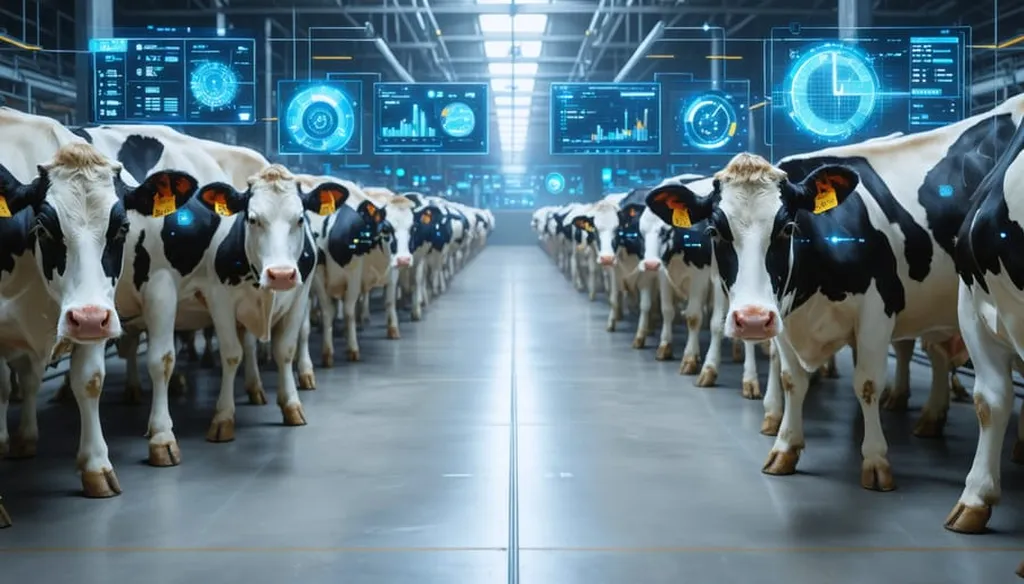
In the heart of Alberta, Canada, a groundbreaking study is reshaping the future of agriculture, merging the worlds of robotics, artificial intelligence, and digital simulation to tackle some of the industry’s most pressing challenges. Emilio Hurtado, a researcher from the Neuroscience Department at the University of Lethbridge, has developed a digital twin framework that could revolutionize robotic vaccination in cattle feedlots, offering a glimpse into the potential of Industry 4.0 and 5.0 technologies in agriculture.
The study, published in *Smart Agricultural Technology*, introduces a robotic vaccination system that leverages digital twins—virtual representations of physical systems—to optimize and validate robotic performance before real-world deployment. This approach not only reduces the need for early-stage physical prototyping but also enhances safety and operational efficiency, providing a cost-effective proof of concept.
At the core of this innovation is NVIDIA Isaac Sim, a state-of-the-art development environment that allows robotic systems to be tested and refined in realistic, dynamic environments. Hurtado’s system combines a robotic arm-based injection mechanism with reinforcement learning agents and a Detectron2 deep learning model, enabling precise neck muscle segmentation and accurate vaccine site targeting. “The digital twin framework allows us to simulate and optimize the robotic vaccination process in a virtual environment, ensuring that the system is both effective and safe before it is deployed in the field,” Hurtado explains.
The research evaluated the system on two robotic platforms: Isaac Sim’s built-in Franka Emika Panda arm and a customized manipulator. Simulation results demonstrated achievable positional accuracy, robust control, and reliable task execution across both platforms. This digital twin-based approach not only reduces the reliance on manual labor but also ensures animal welfare, a critical factor in modern agriculture.
The commercial implications of this research are substantial. By automating the vaccination process, feedlots can improve efficiency, reduce labor costs, and enhance animal welfare, ultimately leading to healthier livestock and higher-quality products. “This technology has the potential to transform the way we manage livestock, making the process more efficient, safer, and more humane,” Hurtado notes.
The study also highlights the broader potential of digital twins in agriculture. As the industry faces increasing pressure to improve efficiency and reduce dependence on manual labor, digital twins offer a transformative approach by enabling virtual representation, real-time simulation, predictive analytics, and performance validation. This framework could pave the way for other automated systems in agriculture, from precision livestock farming to automated harvesting.
As the agriculture sector continues to evolve, the integration of digital twins and robotic systems could become a cornerstone of modern farming practices. Hurtado’s research, published in *Smart Agricultural Technology* and affiliated with the Neuroscience Department at the University of Lethbridge, offers a compelling vision of the future, where technology and agriculture converge to create more sustainable, efficient, and humane systems. The study not only showcases the potential of digital twins in robotic vaccination but also establishes a proof-of-concept pathway for other agricultural applications, highlighting the critical role of digital simulation in enabling practical, scalable automation in modern agriculture.