
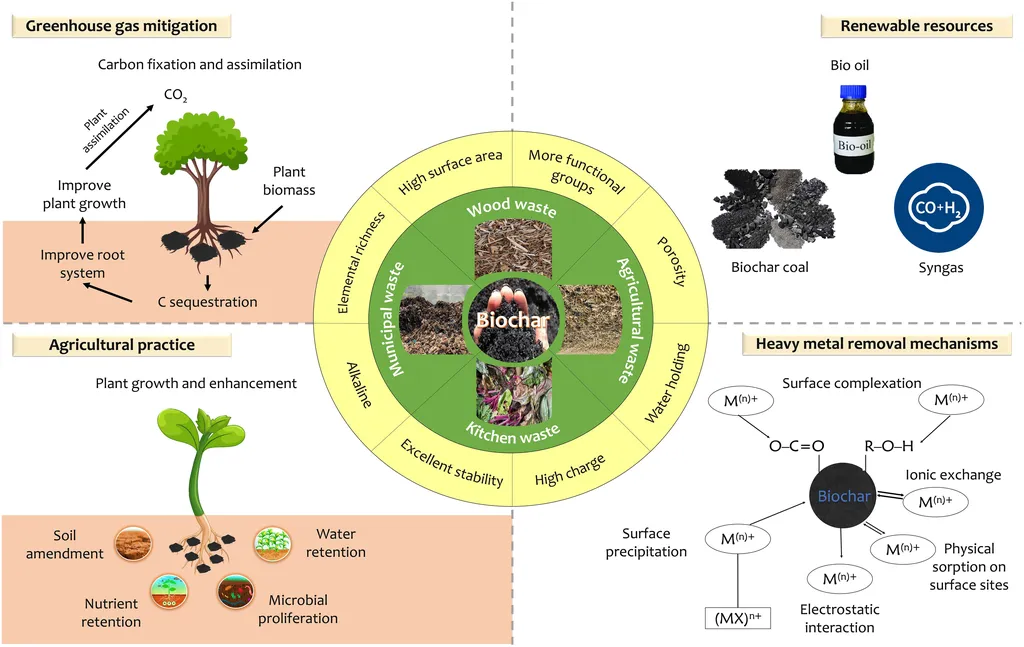
In the quest to combat soil acidification and heavy metal contamination—a growing challenge for intensive agriculture—a team of researchers led by Leizhen Rao from the Key Laboratory of Soil Environment Management and Pollution Control at the Nanjing Institute of Environmental Sciences has uncovered a promising solution. Their study, published in *Eco-Environment & Health*, explores the synergistic effects of biochar-based amendments on copper (Cu) immobilization and carbon sequestration in acidic orchard soils. The findings could revolutionize sustainable soil management practices and offer significant commercial benefits for the agriculture sector.
The research team investigated three types of biochar-based amendments: plain biochar, bacteria-inoculated biochar, and a combination of biochar with oyster shell powder. Each amendment was found to significantly raise soil pH and organic matter content while reducing bioavailable copper by 60%–73%. However, bacteria-inoculated biochar emerged as the standout performer, demonstrating superior capabilities in enhancing soil health and carbon dynamics.
“Bacteria-inoculated biochar not only lowered the microbial metabolic quotient by 44% but also enriched functional microbial taxa, such as Bacillus spp., by a remarkable seven-fold,” explained Rao. This microbial restructuring was accompanied by a notable increase in soil enzyme activity, indicating a more robust and active soil ecosystem.
The study employed advanced techniques such as the diffusive gradient in thin films (DGT) technique, Fourier-transform ion cyclotron resonance mass spectrometry (FT-ICR MS), and high-throughput sequencing to delve into the underlying mechanisms. The results revealed that bacteria-inoculated biochar accelerated the turnover of stable carbon pools, decreasing recalcitrant compounds like lignin and tannin while increasing labile protein and lipid fractions of dissolved organic matter. This dual regulatory role of soil properties and microbial processes highlights a mechanistic linkage between copper immobilization and carbon sequestration.
For the agriculture sector, these findings hold substantial commercial potential. By enhancing soil health and reducing heavy metal bioavailability, bacteria-inoculated biochar can improve crop yields and safety, making it an attractive option for farmers and agribusinesses. Moreover, the increased carbon sequestration capabilities of this amendment can contribute to carbon credit programs, offering additional revenue streams for agricultural enterprises.
The study also underscores the importance of understanding the intricate interplay between soil properties and microbial processes. “Our findings provide new insights into the ecological restoration and sustainable management of contaminated agricultural soils,” said Rao. This research could pave the way for future developments in agritech, driving innovation in soil amendments and sustainable farming practices.
As the agriculture industry continues to grapple with the challenges of soil degradation and environmental contamination, the insights from this study offer a beacon of hope. By harnessing the power of bacteria-inoculated biochar, farmers and researchers alike can work towards a more sustainable and productive future for agriculture.