
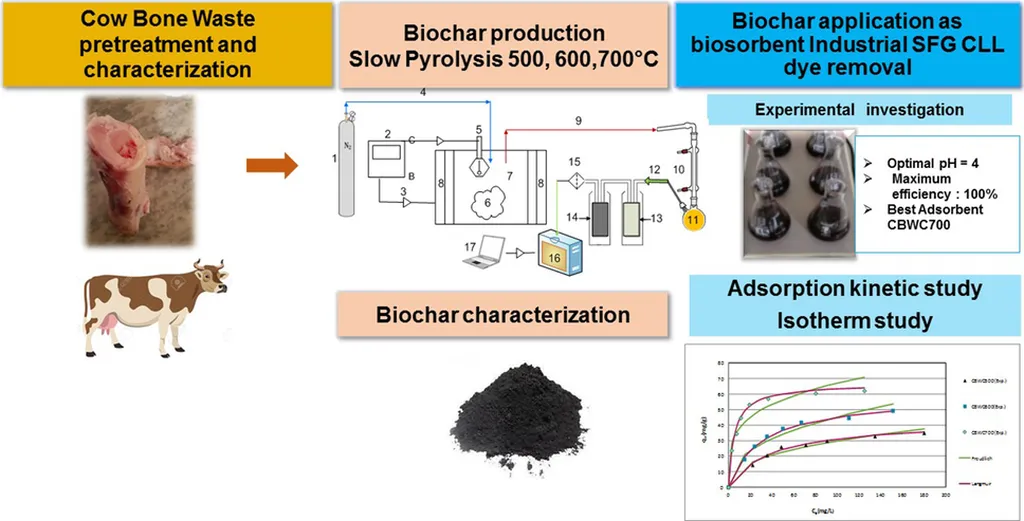
In the quest for sustainable solutions, researchers have turned to an unlikely source: bovine bone waste. A recent study published in *Sustainable Chemistry for Climate Action* outlines a novel method for converting this agricultural byproduct into high-purity, nanocrystalline hydroxyapatite (HA), a material with promising applications in agriculture and beyond. The lead author, Yustina M. Pusparizkita from the Department of Environmental Engineering at Diponegoro University in Semarang, Indonesia, and her team have developed a process that combines calcination and hydrothermal treatment to transform bone waste into a valuable resource.
The process begins with calcination at 900 °C for eight hours, which effectively removes organic matter and produces crystalline HA with a high yield of 90%. This is followed by a hydrothermal treatment using diammonium hydrogen phosphate, which introduces magnesium and sodium ions into the HA structure. The resulting material, carbonated hydroxyapatite, exhibits a Ca/P ratio ranging from 1.6 to 1.9, indicating its potential for various applications.
One of the most significant findings of this study is the nanoscale morphology of the produced HA. Scanning Electron Microscopy (SEM) analysis revealed nanocrystals measuring between 60 and 80 nm, which form non-uniform agglomerates ranging from 0.1 to 0.5 mm in size. This unique structure enhances the material’s surface area and reactivity, making it highly suitable for agricultural applications.
“The combination of high yield, ion substitution, and nanoscale morphology opens up new possibilities for using this material in agriculture,” said Pusparizkita. “Its potential to improve soil health and enhance nutrient availability could have a significant impact on agricultural productivity and sustainability.”
The implications for the agriculture sector are substantial. Hydroxyapatite is known for its ability to slowly release phosphorus, a critical nutrient for plant growth. The ion-substituted carbonated hydroxyapatite produced in this study could provide a more sustainable and efficient way to deliver this essential nutrient to crops. Additionally, the material’s high surface area and reactivity could enhance soil microbial activity and improve overall soil health.
Beyond agriculture, the study’s findings have broader implications for environmental sustainability and biomedical applications. The high-purity, nanocrystalline HA produced through this method could be used in bone tissue engineering, drug delivery systems, and environmental remediation. The versatility of this material makes it a valuable resource for various industries.
“This research demonstrates the potential of agricultural waste to be transformed into high-value materials,” said Pusparizkita. “By developing sustainable methods for producing hydroxyapatite, we can reduce waste and create new opportunities for innovation in agriculture and other sectors.”
The study’s findings highlight the importance of interdisciplinary research in addressing global challenges. By combining principles from environmental engineering, materials science, and agriculture, the researchers have developed a sustainable solution that has the potential to revolutionize multiple industries. As the world continues to seek sustainable and innovative solutions, this research offers a promising path forward.
The study, titled “Synthesizing calcium phosphate powder from bovine bone wastes using calcination and hydrothermal techniques to evaluate physicochemical properties and mineralogy speciation,” was published in *Sustainable Chemistry for Climate Action* and led by Yustina M. Pusparizkita from the Department of Environmental Engineering at Diponegoro University in Semarang, Indonesia.