
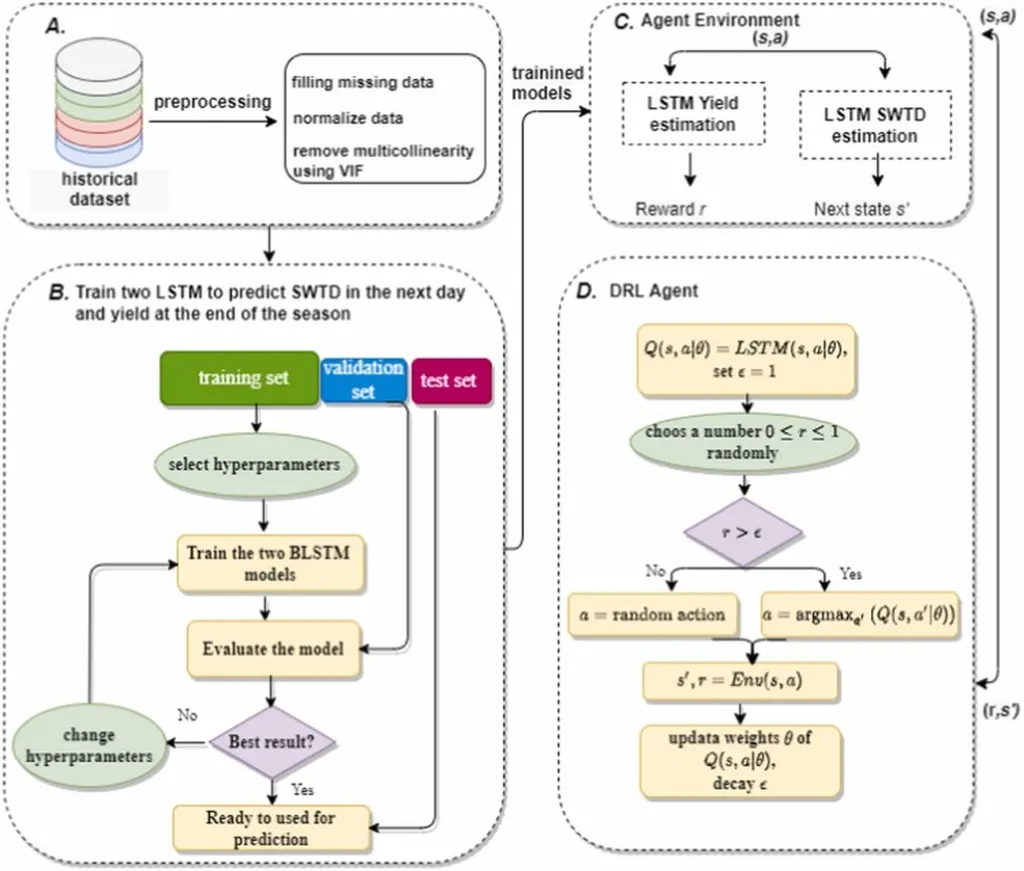
In the quest for sustainable agriculture, precision irrigation stands as a critical frontier. A recent study published in *Agricultural Water Management* sheds light on how Deep Reinforcement Learning (DRL) could revolutionize irrigation strategies, offering both opportunities and challenges for the agriculture sector. The research, led by Jiamei Liu from the Ningbo Innovation Center at Zhejiang University and NingboTech University, explores the potential of DRL to optimize irrigation decisions, potentially transforming how farmers manage water resources.
Irrigation is a complex task, requiring farmers to balance water usage, crop health, and environmental impact. Traditional methods often fall short in dynamic environments, where conditions can change rapidly. Reinforcement Learning (RL) has shown promise in adapting to these changes, but it struggles with high-dimensional data, leading to sub-optimal solutions. Enter Deep Reinforcement Learning (DRL), a fusion of RL and Deep Learning (DL), which excels at learning adaptive and long-term strategies directly from complex data.
“DRL provides a powerful framework for adaptive irrigation,” says Liu. “It can handle dynamic and non-linear environments, making it a valuable tool for multi-objective optimization and decision-making in agriculture.”
The study reviews various applications of DRL in irrigation optimization, including pre-trained environments based on crop growth simulators and dynamic environments driven by real-time sensors. The strengths of classic DRL algorithms are highlighted, particularly their ability to manage complex and evolving conditions. However, the research also identifies significant constraints, such as data scarcity, poor model interpretability, and difficulties in field deployment.
One of the key challenges is the gap between simulation and real-world complexity. While DRL performs well in controlled environments, translating these successes to the field remains a hurdle. To address this, the study suggests developing multi-objective DRL algorithms that can better handle the intricacies of real-world agriculture.
The commercial implications for the agriculture sector are substantial. Efficient irrigation not only conserves water but also enhances crop yields and reduces costs. As climate change and water scarcity become increasingly pressing issues, technologies like DRL could provide the adaptive strategies needed to ensure sustainable farming practices.
Looking ahead, the research points to a future where DRL could play a pivotal role in smart agriculture. By improving modeling outcomes and bridging the gap between simulation and reality, DRL has the potential to support sustainable resource management and boost agricultural productivity.
As the agriculture sector continues to evolve, the integration of advanced technologies like DRL could be a game-changer. The study by Jiamei Liu and colleagues offers a glimpse into this promising future, highlighting both the opportunities and the challenges that lie ahead.