
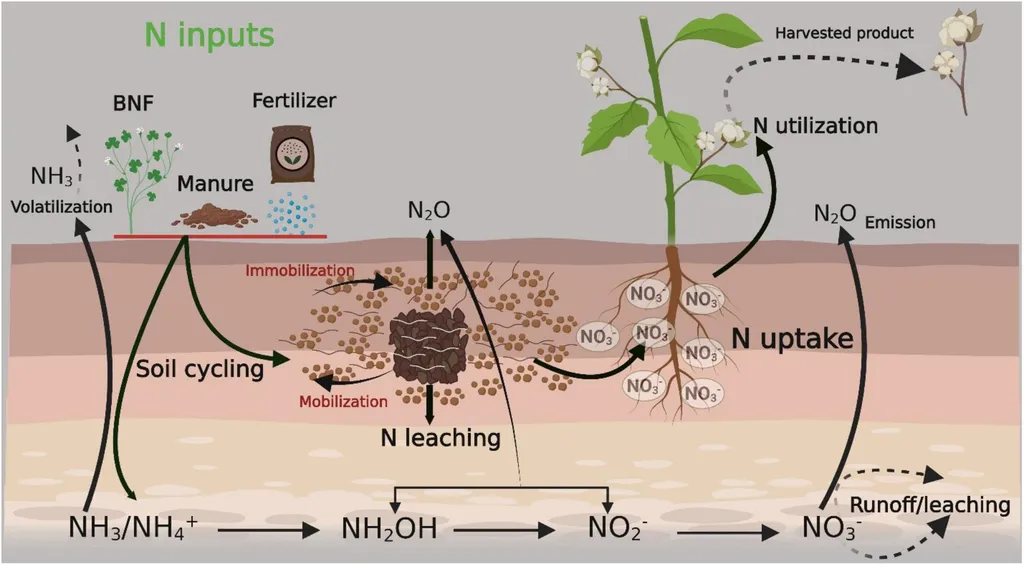
In the quest to boost productivity of poplar plantations in semi-arid regions, researchers have uncovered a nuanced relationship between nitrogen addition and drought stress that could reshape agricultural practices. A recent study published in *Industrial Crops and Products* reveals that while nitrogen (N) fertilization can significantly enhance growth under moderate drought conditions, its benefits diminish under severe drought, offering critical insights for farmers and agronomists.
The study, led by Weifeng Wang from the College of Forestry at Shanxi Agricultural University, investigated how nitrogen addition affects carbon assimilation and biomass accumulation in poplar seedlings under varying drought levels. The findings highlight a promising strategy for improving crop resilience in water-scarce environments, but with important caveats.
Under moderate drought conditions (40% of field capacity), nitrogen addition led to a marked improvement in poplar seedling health. “Nitrogen addition significantly increased the activities of antioxidases, nitrate reductase by 39%, and nitrogen concentration in leaves by 56%,” Wang explained. This boost in physiological processes translated into a 69% increase in leaf area, a 34% rise in net photosynthesis rate, and a substantial alleviation of growth restrictions. Essentially, nitrogen acted as a growth enhancer, helping plants thrive despite water scarcity.
However, the story changes under severe drought (20% of field capacity). While nitrogen addition still increased the accumulation of soluble sugars and nitrogen in the whole plant, it failed to mitigate damage to membranes and photosystem II or improve chlorophyll content, leaf area, or biomass accumulation. “Under severe drought, nitrogen addition did not ameliorate the damage to membranes and photosystem II, nor did it improve chlorophyll content, leaf area, or biomass accumulation,” Wang noted.
The study underscores the importance of tailoring nitrogen fertilization strategies to specific drought conditions. For the agriculture sector, this means a more precise, context-dependent approach to fertilizer use, which could lead to more sustainable and productive poplar plantations. “The findings suggest that applying nitrogen fertilizer can enhance the growth of hybrid poplar under mild drought conditions, but it has no significant effect in severe drought conditions,” Wang said.
This research could shape future developments in agritech by encouraging the development of smart fertilization systems that adapt to real-time environmental conditions. By integrating data on soil moisture and plant health, farmers could optimize nitrogen application, maximizing yields while minimizing waste and environmental impact. As drought conditions become more prevalent due to climate change, such innovations will be crucial for maintaining agricultural productivity.
In summary, the study offers a roadmap for leveraging nitrogen fertilization to boost crop resilience, but it also serves as a reminder that one-size-fits-all solutions may not be effective. As the agriculture sector grapples with the challenges of climate change, this research provides a valuable tool for developing more adaptive and sustainable farming practices.