
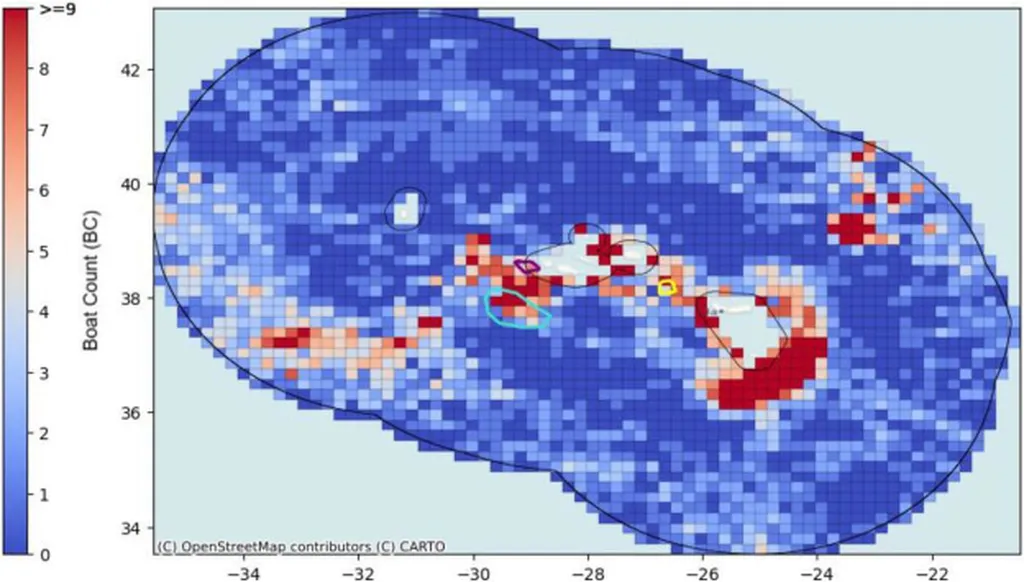
In the vast expanse of the Atlantic Ocean, the Azores archipelago stands as a bastion of marine biodiversity, its waters teeming with life and its seamounts serving as vital ecosystems. Yet, this delicate balance is under threat, as a new study reveals the stark reality of fishing pressure in the region’s Marine Protected Areas (MPAs). The research, published in ‘Aquaculture and Fisheries’ and led by Ricardo Moura from the Portuguese Naval Academy and NOVA School of Science and Technology, sheds light on the prevalence of illegal fishing and the effectiveness of enforcement efforts in the Azores.
The study combines Vessel Monitoring System (VMS) records from 2016 to 2022 and Portuguese Navy Fiscalization Reports (FISCREP) from 2015 to 2022 to paint a comprehensive picture of fishing effort in the Azores Exclusive Economic Zone (EEZ). By introducing the Total Boat-Meter (TBM) metric, which accounts for both the number and length of boats, the research provides a nuanced understanding of the fishing pressure exerted on these protected waters.
“Our analysis shows that the fishing effort in the protected areas is very high,” Moura explains. “This highlights the immense pressure on the protected ecosystems and underscores the need for more robust management strategies.”
The findings are a wake-up call for the fisheries industry, which relies heavily on sustainable practices to ensure long-term viability. Illegal, unreported, and unregulated fishing not only threatens marine biodiversity but also undermines the economic stability of legitimate fishing operations. The Azores, with its traditional multispecific fishery, is a crucial player in the global seafood market, and the health of its ecosystems is directly tied to the prosperity of its fishing communities.
The study’s insights could shape future developments in fisheries management, prompting regulatory institutions to reassess their strategies and adopt more effective enforcement measures. By leveraging advanced metrics like TBM, policymakers can make data-driven decisions that balance the needs of the fishing industry with the imperative of conservation.
As Moura notes, “This research aims to assist regulatory institutions and researchers in assessing fishing pressure and promoting sustainable fisheries management in the Azores.” The hope is that by understanding the current state of affairs, stakeholders can work together to preserve the marine ecosystems that sustain both the environment and the economy.
In an era where the global population continues to grow and hunger remains a pressing issue, the need for sustainable fisheries management has never been more critical. The Azores, with its rich marine resources, stands at the forefront of this challenge. The research led by Moura and his team serves as a crucial step towards ensuring that the waters of the Azores remain a thriving ecosystem for generations to come.