
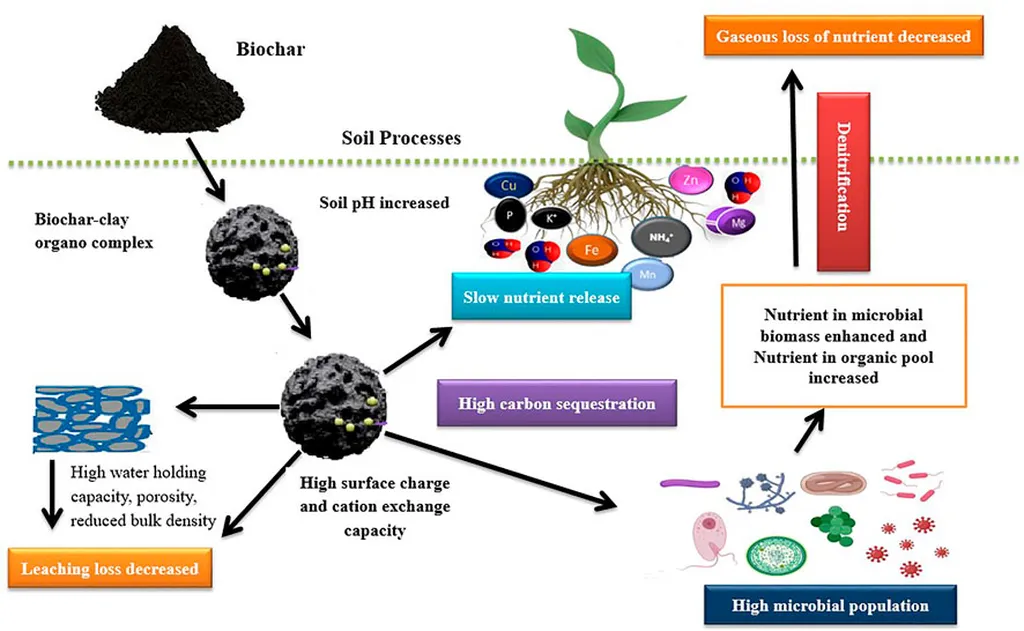
In the heart of the Nile Delta, a groundbreaking study is reshaping our understanding of soil water dynamics and offering a promising solution to water scarcity in agriculture. Researchers have discovered that mesoporous biochar, when combined with nitrogen management, can significantly alter soil properties and water use in regions with shallow groundwater tables.
The study, led by Maha Elbana from the Soil and Water Science Department at Beni-Suef University, Egypt, found that applying biochar at a rate of 35 tons per hectare, combined with varying levels of nitrogen fertilization, created an S-shaped soil moisture profile within the top 30 cm of soil. This is a stark contrast to the typical monotonic moisture increase observed in shallow groundwater conditions.
“Instead of a gradual increase in moisture, we saw a distinct pattern that suggests biochar is enhancing water retention and distribution in the root zone,” Elbana explained. This alteration in soil moisture dynamics led to a significant reduction in drainage losses, particularly when biochar was combined with moderate nitrogen input.
The implications for the agriculture sector are substantial. The study found that the biochar-nitrogen combination reduced irrigation demand by approximately 82 cubic meters per hectare per year compared to conventional management practices. When scaled regionally under similar environmental conditions, this strategy could save over 80 million cubic meters of irrigation water annually in Egypt, assuming 100% irrigation efficiency.
The research, published in *Frontiers in Soil Science*, highlights the potential of mesoporous biochar to enhance water-use efficiency in water-scarce regions. While the study did not find statistically significant improvements in crop yield and fruit quality, the water savings alone present a compelling case for adopting this strategy.
This study opens up new avenues for research and commercial application. As water scarcity becomes an increasingly pressing issue, the agricultural sector is looking for innovative solutions to improve water productivity. Mesoporous biochar offers a promising strategy to reshape root-zone water dynamics and enhance water-use efficiency.
The findings suggest that future developments in agritech should focus on integrating biochar with nitrogen management to optimize soil water dynamics. This could lead to the development of new products and practices that not only improve water-use efficiency but also enhance crop productivity and quality.
In the quest for sustainable agriculture, this research provides a beacon of hope. By reshaping soil water dynamics, mesoporous biochar could help farmers in water-scarce regions to grow more with less, ensuring food security and environmental sustainability for generations to come.