
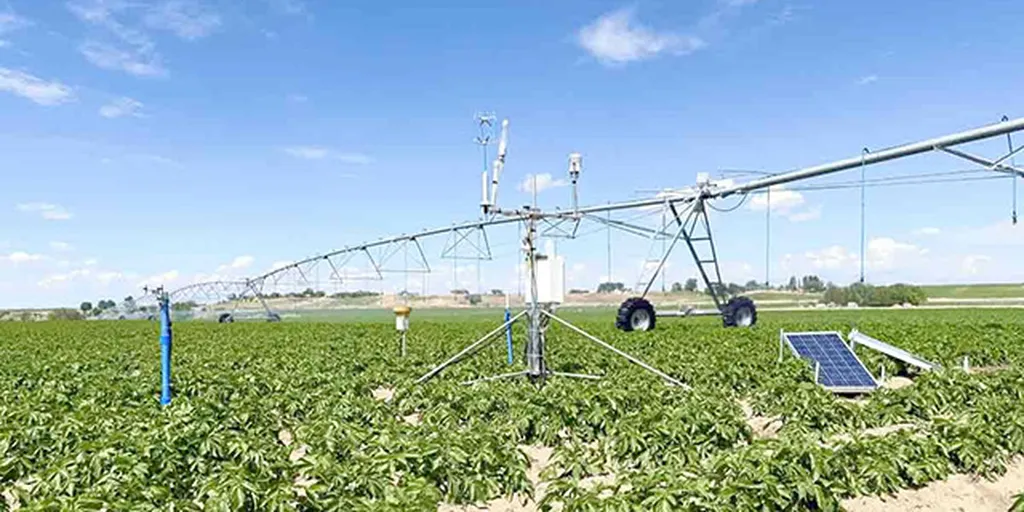
In the heart of Idaho’s Magic Valley, a groundbreaking study is reshaping how we think about water management in agriculture. Researchers, led by Chinmay Deval from the University of Alabama in Huntsville and the University of Idaho, have uncovered persistent patterns in crop water use (CWU) that could revolutionize precision agriculture and variable rate management.
The study, published in *Environmental Research: Water*, analyzed 16 years of 30-meter gridded seasonal consumptive irrigation requirement maps. These maps, developed by the University of Idaho and the Idaho Department of Water Resources, provided a detailed look at actual evapotranspiration, or crop water uptake, across irrigated areas.
The findings are significant. “We found that certain patterns in crop water use persist over time within field zones,” Deval explained. “This persistence is influenced by factors such as the dominant crop type, within-field topographic differences, soil physical properties, and the water source used in irrigation.”
One of the most intriguing discoveries was the reduced CWU near field edges, a phenomenon that doesn’t manifest in fields surrounded by other irrigated fields due to the “oasis effects” from neighboring fields. This insight could have profound implications for water management strategies.
The study employed advanced statistical analysis and the Boruta feature selection algorithm to identify these patterns. The resulting persistence maps offer valuable insights for growers, agronomists, and water managers, enabling them to allocate water resources more efficiently and optimize crop yields.
The commercial impact of this research is substantial. By identifying specific areas within fields that could benefit from variable rate management, farmers can make more informed decisions about water allocation. This not only enhances crop productivity but also promotes sustainable water use, a critical concern in the face of climate change and increasing water scarcity.
As precision agriculture continues to evolve, this study provides a cost-effective and efficient methodology for evaluating field variability. It paves the way for future developments in variable rate management, offering a blueprint for optimizing resource allocation in agriculture.
In the words of Deval, “This research advances our understanding of persistent CWU patterns and contributes to the development of more sustainable and efficient farming practices.” The implications for the agriculture sector are vast, promising a future where water resources are managed with unprecedented precision and efficiency.