
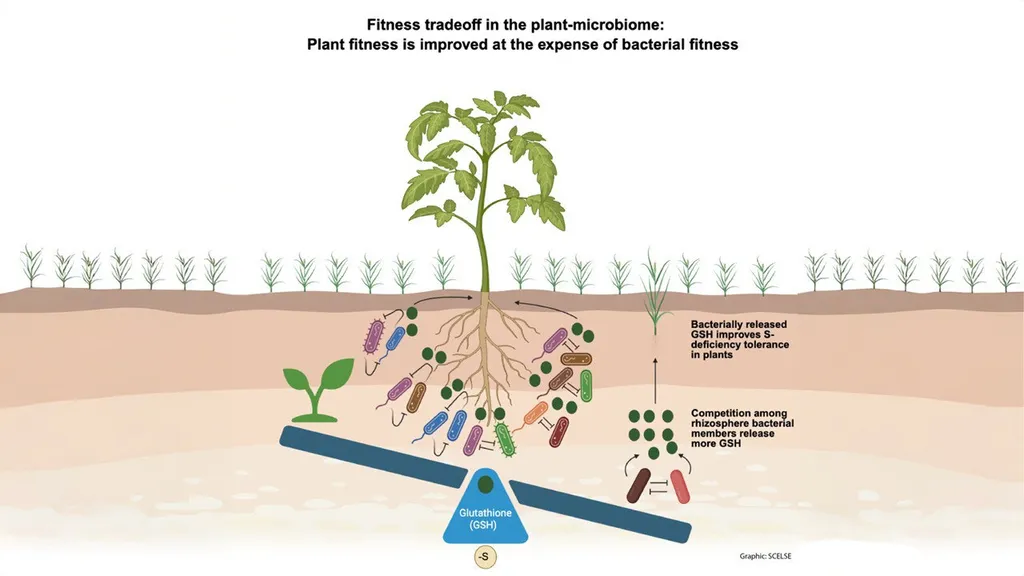
In the ever-evolving landscape of agriculture, understanding the intricate dance between soil microbes and plant productivity is becoming increasingly crucial. A recent study published in *Advanced Science* sheds light on how soil nutrient enrichment can induce trade-offs in bacterial life-history strategies, ultimately impacting plant growth and productivity. This research, led by Yuanyuan Yan from the State Key Laboratory of Climate System Prediction and Risk Management at Nanjing Normal University, offers valuable insights that could reshape nutrient management strategies in precision agriculture.
The study integrates large-scale observational data with controlled experiments to evaluate how soil nutrient enrichment affects bacterial functional potential and growth-rate potential. The findings reveal stark contrasts between nutrient-poor open field (OF) soils and nutrient-rich greenhouse (GH) soils. In OF soils, microbial communities dominated by oligotrophs—organisms adapted to low-nutrient environments—exhibit higher taxonomic diversity and larger average genome sizes. These communities are rich in nutrient-cycling genes but show lower growth rates. Conversely, GH soils, dominated by copiotrophs—organisms thriving in nutrient-rich conditions—demonstrate higher growth-rate potential and a greater diversity of functional genes, including those involved in biofilm formation, secondary metabolism, and bacterial chemotaxis.
“Our findings highlight a nutrient-driven trade-off between bacterial functional potential and growth rate,” explains Yan. “This trade-off has significant implications for optimizing nutrient management strategies in precision agriculture.”
The study’s controlled pot experiments further demonstrate that GH-enriched microbial functions strongly promote plant growth, particularly under sufficient nutrients and abiotic stress. This suggests that understanding and leveraging these microbial dynamics could enhance plant productivity and resilience in agricultural settings.
For the agriculture sector, these insights are particularly valuable. Precision agriculture aims to optimize crop yields while minimizing environmental impact. By understanding how nutrient enrichment affects microbial communities, farmers and agronomists can develop more targeted and effective nutrient management strategies. This could lead to improved crop yields, reduced fertilizer use, and enhanced sustainability.
The research also opens up new avenues for exploring the role of microbial communities in plant health and productivity. Future developments in this field could focus on identifying specific microbial strains that promote plant growth under various environmental conditions. Additionally, advancements in biofertilizers and microbial inoculants could further enhance agricultural productivity and sustainability.
As the agriculture sector continues to evolve, the integration of microbial ecology into precision agriculture practices will be crucial. This study provides a foundation for future research and practical applications, offering a glimpse into the complex interplay between soil microbes and plant productivity. By harnessing the power of microbial communities, the agriculture sector can look forward to more sustainable and productive farming practices in the years to come.