
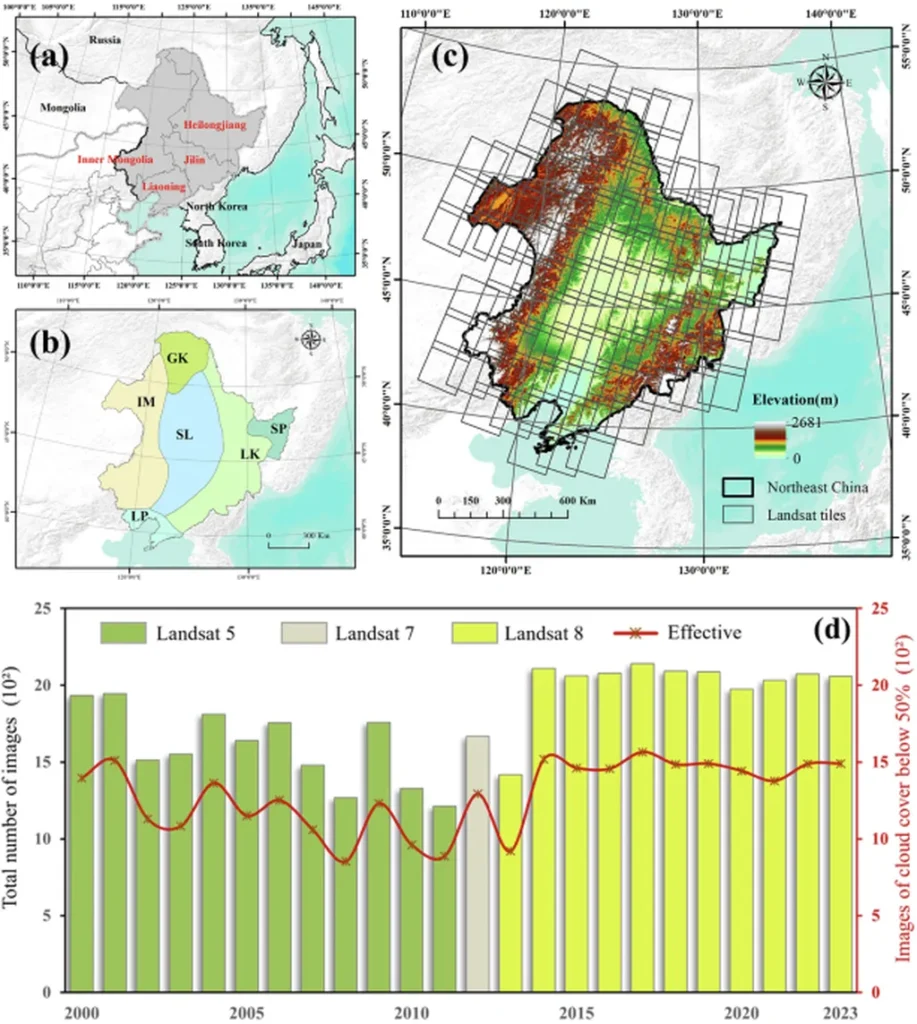
In a groundbreaking development for agricultural monitoring and food security, researchers have successfully mapped the spatiotemporal dynamics of paddy rice cultivation across Northeast China from 1985 to 2023 using deep learning and innovative data enhancement techniques. This study, published in *Earth System Science Data*, leverages multi-sensor Landsat data and a deep learning model known as the full resolution network (FR-Net) to provide unprecedented insights into the expansion of paddy rice in one of China’s most critical agricultural regions.
The research, led by Z. Zhang from the State Key Laboratory of Efficient Utilization of Arid and Semi-arid Arable Land in Northern China at the Institute of Agricultural Resources and Regional Planning, Chinese Academy of Agricultural Sciences, addresses a longstanding challenge in crop mapping: the limited understanding of how paddy rice cultivation has evolved over time. By creating a cross-sensor paddy training dataset comprising 155 Landsat images, the team was able to map paddy rice with remarkable accuracy. The study introduces the annual result enhancement (ARE) method, which integrates differences in category probability and confidence levels of the FR-Net across phenological stages. This method significantly reduces classification uncertainty, a critical advancement for large-scale and cross-sensor paddy rice mapping.
“The ARE method considers the differences in category probability of FR-Net at different stages to diminish the impact of the limited training sample,” explained Zhang. “This approach could mitigate the impact of limited training sample on large-scale and across-sensor paddy rice mapping.”
The accuracy of the paddy rice dataset was rigorously evaluated using 107,954 ground truth samples. Compared to traditional rice mapping methods, the ARE method showed a 5% increase in the F1 score, a metric that balances precision and recall. The overall mapping result achieved high average values of user accuracy (UA) of paddy, producer accuracy (PA) of paddy, overall accuracy (OA), F1 score, and Matthews correlation coefficient (MCC) of 0.93, 0.91, 0.91, 0.92, and 0.82, respectively. These metrics underscore the reliability and precision of the new method.
The study revealed a substantial increase in paddy rice cultivation area in Northeast China, expanding from 1.11 million to 6.45 million square kilometers between 1985 and 2023. This represents an overall expansion of 5.34 million square kilometers, with the highest growth occurring in Heilongjiang province, where the area increased by 4.33 million square kilometers.
The implications of this research are profound for the agriculture sector. Accurate and long-term crop mapping enables farmers and policymakers to make timely adjustments to cultivation patterns, ensuring food security and optimizing resource allocation. “This study shows that long-history crop mapping could be achieved with deep learning, and the result of paddy rice will be beneficial for making timely adjustments to cultivation patterns and ensuring food security,” Zhang noted.
As the agriculture sector continues to grapple with the challenges of climate change, resource scarcity, and the need for sustainable practices, advancements in crop mapping and monitoring are more critical than ever. This research not only provides a robust methodology for tracking paddy rice cultivation but also sets a precedent for applying deep learning to other crops and regions. The commercial impacts are significant, as precise data can inform better decision-making, enhance productivity, and support the development of resilient agricultural systems.
In an era where data-driven insights are transforming industries, this study highlights the potential of deep learning to revolutionize agriculture. By providing a clear, accurate, and comprehensive view of paddy rice cultivation dynamics, researchers have laid the groundwork for future developments in agricultural monitoring and food security. As the agriculture sector continues to evolve, the integration of advanced technologies like deep learning will be essential in meeting the growing demands of a global population.