
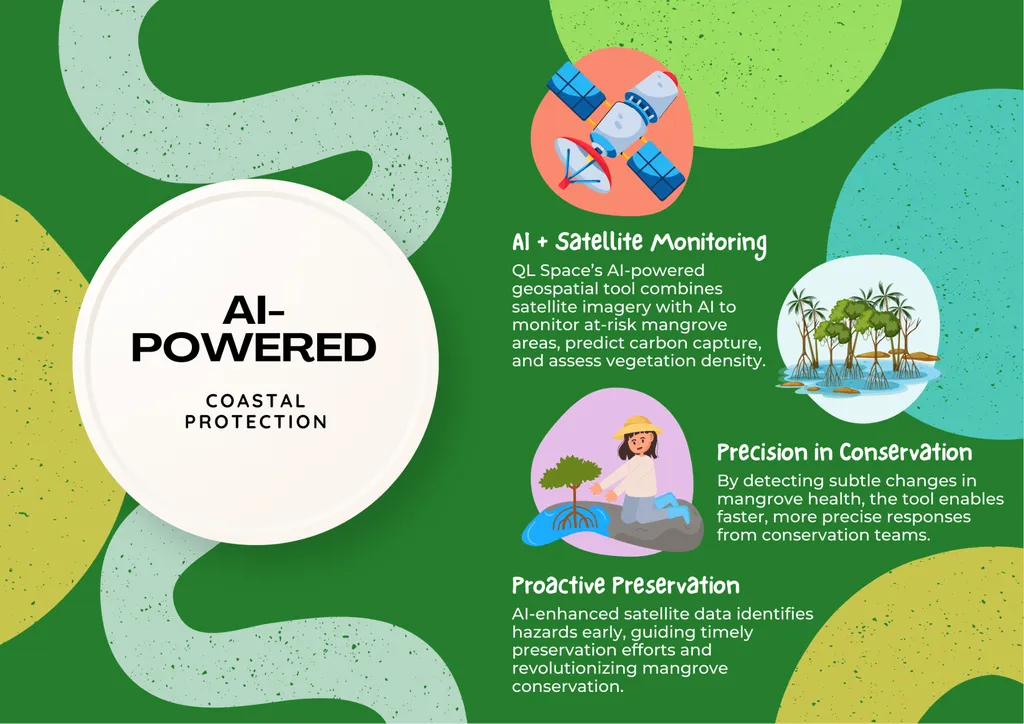
In the fight against climate change, mangroves have emerged as unsung heroes, acting as critical blue-carbon habitats that sequester vast amounts of carbon. A recent study published in *iScience* has shed new light on the carbon stock assessment of mangrove habitats, combining field measurements with cutting-edge machine learning and remote sensing techniques. The research, led by Khaled Al-Jabri from the Department of Soils, Water and Agricultural Engineering at Sultan Qaboos University in Oman, offers promising insights for carbon accounting, conservation planning, and even commercial agriculture.
Mangroves, particularly those in hyper-arid environments, have long been recognized for their role in carbon sequestration. However, accurately assessing their aboveground biomass (AGB) and carbon stocks has been a challenge. Al-Jabri and his team tackled this issue by integrating destructive sampling, field surveys, and high-resolution Pléiades Neo satellite imagery. The result was a newly developed allometric model that achieved high accuracy, estimating carbon storage at 0.023 t C per tree for diameters ranging from 4.5 to 13.0 cm.
The study also employed machine learning-based remote sensing models, which proved to be highly reliable. “The use of spectral indices and canopy reflectance for biomass prediction opens up new avenues for large-scale, cost-effective monitoring of mangrove ecosystems,” Al-Jabri explained. This approach not only enhances our understanding of mangrove carbon stocks but also provides practical tools for conservation planning and carbon offset frameworks.
The implications of this research extend beyond environmental science. For the agriculture sector, the integration of remote sensing and machine learning offers a blueprint for precision agriculture. Farmers and agribusinesses could leverage similar technologies to monitor crop health, optimize resource use, and enhance productivity. “The methodologies we’ve developed can be adapted to various agricultural contexts, providing valuable data for sustainable farming practices,” Al-Jabri noted.
Moreover, the study highlights the importance of standardized biomass assessment methodologies. As global efforts to combat climate change intensify, accurate carbon accounting becomes increasingly crucial. The techniques developed in this research could be applied to other ecosystems, offering a scalable solution for carbon stock assessment.
The research also underscores the need for interdisciplinary collaboration. By combining field measurements with advanced technologies, scientists can gain a more comprehensive understanding of complex ecosystems. This holistic approach is essential for developing effective conservation strategies and mitigating the impacts of climate change.
As we look to the future, the integration of remote sensing, machine learning, and field measurements holds immense potential. From enhancing carbon accounting to revolutionizing agriculture, these technologies are poised to shape the next generation of environmental and agricultural practices. The study by Al-Jabri and his team is a testament to the power of innovation in addressing global challenges.