
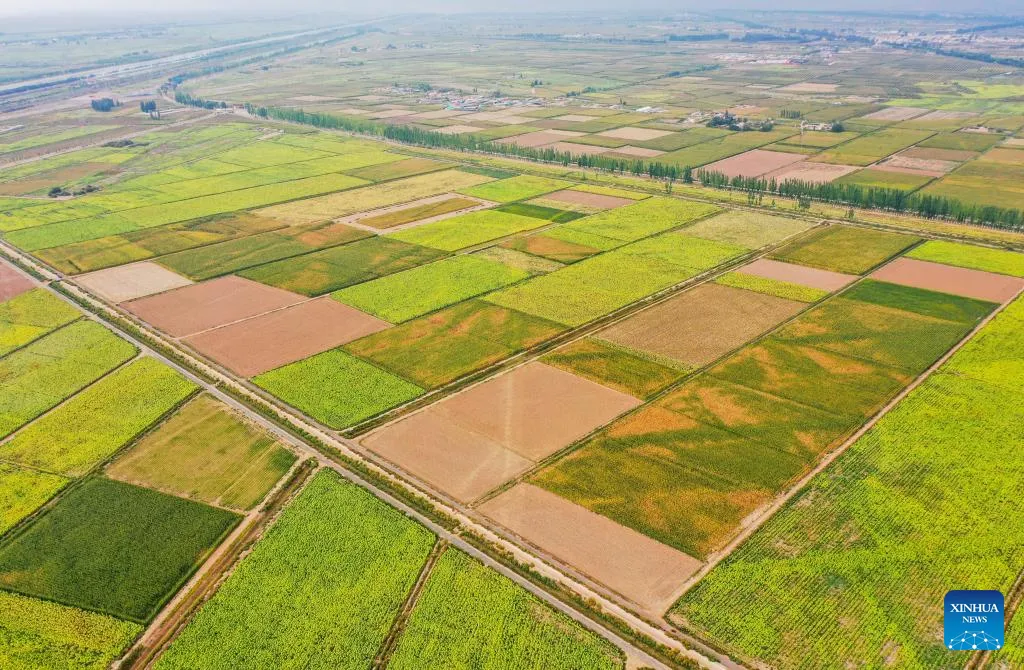
In the vast, arid expanse of Inner Mongolia’s Hetao Irrigation District (HID), a delicate dance between water scarcity and agricultural productivity is playing out. As the largest gravity-fed irrigation district in Asia, HID is a critical grain and oil production hub for China. However, the growing scarcity of Yellow River water resources has necessitated a reevaluation of irrigation practices, particularly the non-growing season irrigation regime comprising Autumn Irrigation (AI) and Spring Irrigation (SI).
A recent study published in ‘Agricultural Water Management’ and led by Chunan Xiao from the State Key Laboratory of Water Resources Engineering and Management at Wuhan University, delves into the spatiotemporal evolution of crop planting structure and irrigation areas in the HID. The research proposes an optimized water allocation scheme for AI and SI, aiming to mitigate soil salinization and improve water use efficiency under constrained water resources.
The study reveals that from 2016 to 2023, sunflower occupied the largest planting area in the HID, followed by maize and wheat. Notably, the planting areas of sunflower and maize exhibited an increasing trend, while that of wheat decreased. The area of SI decreased while that of AI increased before 2023, with both trends reversing in 2023.
The optimized water allocation scheme recommends specific irrigation quotas for different soil types. For lightly saline-alkali land, the suitable irrigation quotas are 780–1230 m³/ha for SI and 1650 m³/ha for AI. For moderately saline-alkali land, the quotas are 1080–1305 m³/ha for SI and 1800 m³/ha for AI. The recommended area for AI is 336,107 ha with 1.183 billion m³ of water use, and for SI, it is 383,380 ha with 0.908 billion m³.
“This study provides a crucial framework for optimizing irrigation strategies under water constraints,” said Xiao. “By improving water use efficiency and reducing soil salinization, we can contribute to sustainable agricultural development in cold and arid regions.”
The commercial implications of this research are significant. As water resources become increasingly scarce, farmers and agricultural businesses must adopt more efficient irrigation practices to maintain productivity. The optimized water allocation scheme proposed in this study offers a practical solution for balancing water use and crop production, ensuring the long-term viability of agriculture in water-scarce regions.
Moreover, the study’s findings could influence policy decisions and water management strategies in other arid regions facing similar challenges. By sharing this research, we can foster a global dialogue on sustainable agriculture and water resource management, ultimately shaping the future of agritech and food security.
As the world grapples with the realities of climate change and water scarcity, innovative solutions like those presented in this study will be crucial in ensuring the resilience and sustainability of our agricultural systems. The research not only addresses immediate concerns but also paves the way for future developments in the field, offering hope for a more secure and sustainable agricultural future.