
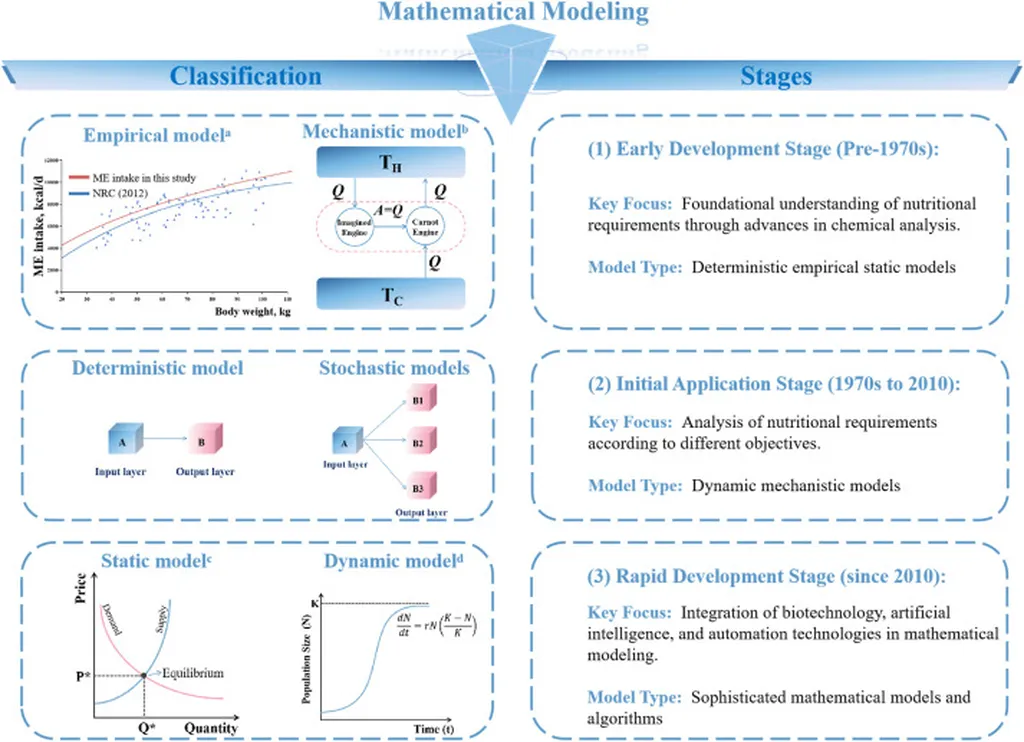
In the rapidly evolving world of pig production, precision nutrition is emerging as a game-changer, and a recent review published in *Agriculture Communications* sheds light on how mathematical modeling is paving the way. Led by Qile Hu from the State Key Laboratory of Animal Nutrition and Feeding at China Agricultural University, the research highlights the transformative potential of integrating advanced algorithms and data-driven techniques into pig farming practices.
Precision nutrition, the practice of tailoring diets to the specific needs of individual animals, is not a new concept. However, the tools and technologies available to achieve it are evolving at an unprecedented pace. Hu and his team at the Ministry of Agriculture and Rural Affairs Feed Industry Centre (MAFIC) have been at the forefront of this evolution, exploring how mathematical modeling can enhance the accuracy and efficiency of nutritional strategies in pig production.
“Mathematical modeling is a powerful tool for integrating data and making predictions,” Hu explains. “But to truly achieve precision nutrition, we need to overcome challenges like insufficient data and outdated algorithms.” The review underscores the importance of developing new data-collection methodologies and advanced algorithms to meet these challenges. Two innovative techniques—heart rate monitoring and bioelectrical impedance analysis—are highlighted for their ability to provide real-time predictions of heat production and body composition analysis in pigs. These non-invasive, cost-effective, and portable methods offer a significant advantage over traditional approaches.
The research also delves into the role of advanced algorithms, including classification algorithms, artificial neural networks, and interpretable machine learning algorithms. These tools are crucial for forecasting the net energy values of feedstuffs, constructing nutrient requirement tables, and predicting the growth performance of pigs. “By leveraging big data and numerous parameters, we can create more accurate and personalized nutrition plans,” Hu notes. This level of precision not only optimizes the health and growth of pigs but also has substantial commercial implications for the agriculture sector.
The integration of new software and hardware, such as big data analysis platforms and AI feed formulation software based on large language model architecture, further enhances the potential for precision nutrition. These technological advancements enable farmers to make data-driven decisions, ultimately improving productivity and profitability. “The future of precision feeding equipment is also of great interest,” Hu adds. “Integrating mathematical models with these new methods, algorithms, and software will provide robust theoretical and practical guidance for the successful implementation of precision nutrition in pig production.”
The commercial impacts of this research are far-reaching. By optimizing dietary structures and personalized nutrition plans, farmers can reduce feed costs, minimize waste, and enhance the overall efficiency of their operations. This not only benefits individual producers but also contributes to the sustainability and resilience of the broader agriculture sector.
As the pig industry continues to embrace artificial intelligence and interdisciplinary integration, the work of Hu and his team offers a glimpse into the future of precision nutrition. The review published in *Agriculture Communications* serves as a call to action for researchers, farmers, and industry stakeholders to collaborate and innovate, ensuring that the full potential of precision nutrition is realized. The journey towards achieving this goal is complex and multifaceted, but the rewards—both economic and environmental—are substantial.