
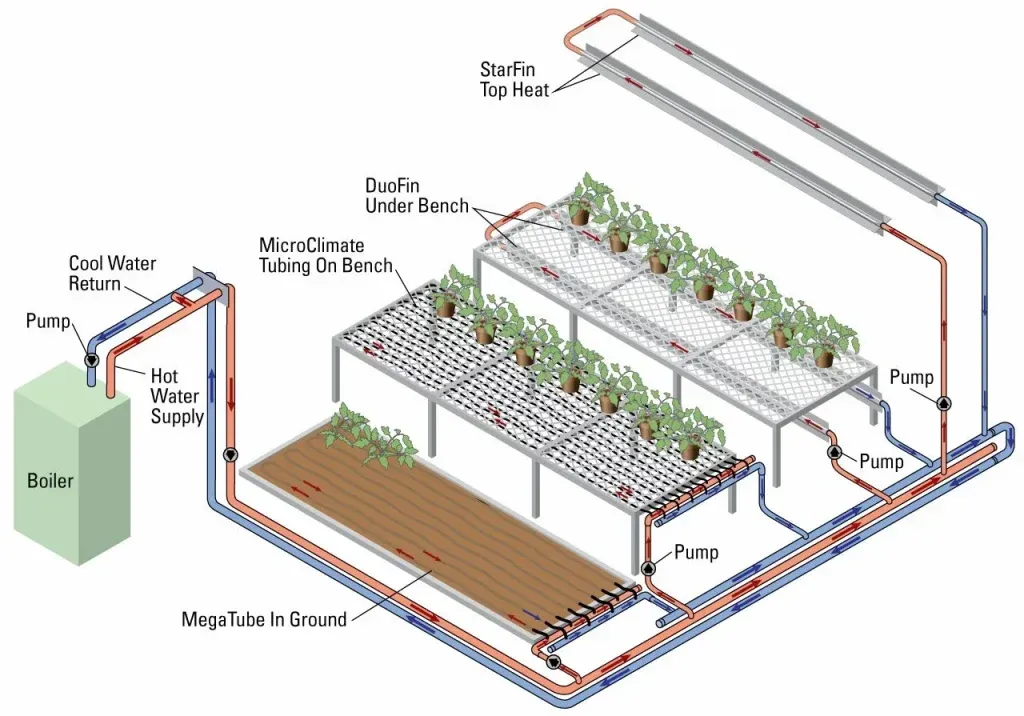
In the quest for sustainable agriculture, researchers have turned their attention to one of the most energy-intensive aspects of greenhouse cultivation: heating. A recent study published in the *Journal of Engineering* offers a promising solution to optimize heating systems using gas radiant technologies, potentially revolutionizing energy efficiency in the agriculture sector.
Heating accounts for up to half of the energy consumption in greenhouse crop production, making it a critical area for innovation. The study, led by Khristina Maksudovna Vafaeva from Peter the Great St. Petersburg Polytechnic University, addresses the practical issue of energy loss through heat in greenhouses with limited thermal insulation. The research proposes an innovative engineering method for gas radiant heating systems, built on heat and mass transfer theory.
The model developed by Vafaeva and her team predicts specific thermal requirements for greenhouses, including a preheated inlet air temperature of -11.6°C, an enclosure surface temperature of 18.6°C, and a radiant power need of 68.7 kW. The total combined thermal load required is estimated at 104.2 kW. These predictions were confirmed and validated in laboratory trials, with no greater deviation than -3.8% between calculated and measured data.
“This methodology provides a practical and accurate method for the design and optimization of greenhouse heating systems using gas infrared technologies,” Vafaeva explained. The implications for the agriculture sector are significant. By optimizing heating systems, farmers can reduce energy costs and environmental impact, contributing to more sustainable and climate-resilient crop production.
The commercial impact of this research could be profound. As the demand for locally grown, year-round produce increases, so does the need for energy-efficient greenhouses. Implementing optimized heating systems could make a substantial difference in operational costs and carbon footprint. “Our model not only enhances energy efficiency but also ensures that greenhouse conditions are ideal for crop growth, ultimately benefiting both farmers and consumers,” Vafaeva added.
The study’s findings open doors for future developments in greenhouse technology. As the agriculture sector continues to seek sustainable solutions, the integration of advanced heating systems could become a standard practice. This research underscores the importance of innovative engineering in addressing real-world challenges, paving the way for a more efficient and environmentally friendly future in agriculture.
With the validation of this model, the agriculture industry may soon see a shift towards more energy-efficient practices, driven by the need for sustainability and cost-effectiveness. The work of Vafaeva and her team, published in the *Journal of Engineering*, represents a significant step forward in this direction, offering a blueprint for optimizing greenhouse heating systems and contributing to the broader goals of sustainable agriculture.