
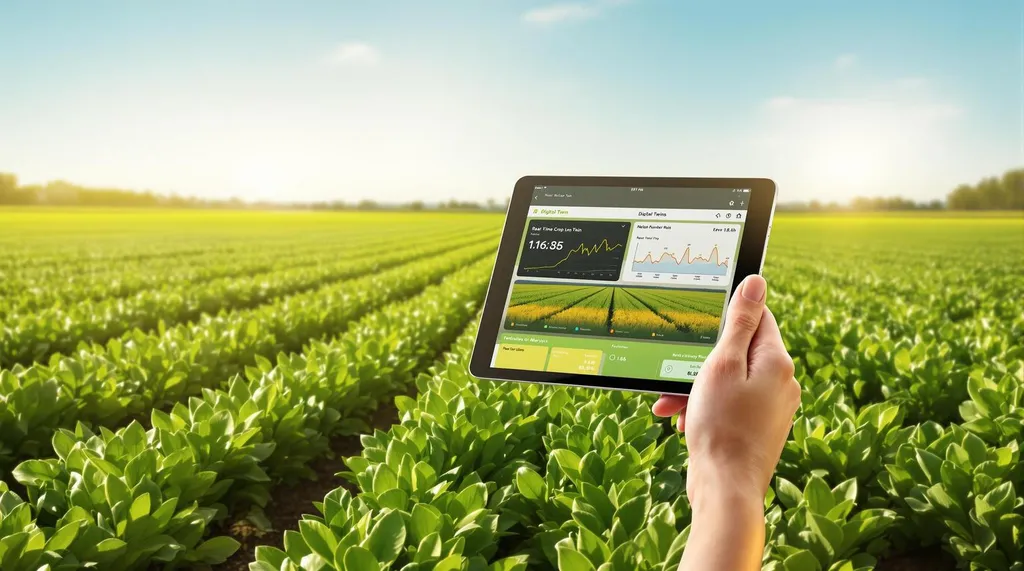
In the rapidly evolving landscape of smart farming, a groundbreaking innovation is taking root: the Agricultural Digital Twin (ADT). This cutting-edge technology is poised to revolutionize the way we approach agriculture, promising to enhance productivity and sustainability in ways previously unimaginable. A recent study published in *Green Technologies and Sustainability* delves into the transformative potential of ADTs, offering a comprehensive analysis of their applications and challenges.
The study, led by A. Subeesh from the Department of Computer Science and Engineering at the National Institute of Technology Hamirpur and the Centre of Excellence on Agri-Electronics and Automation in Agriculture at ICAR- Central Institute of Agricultural Engineering, Bhopal, explores how digital twin modeling can accurately represent physical entities and provide functional services tailored to modern farms. “Digital twin modeling is essential for accurately representing the physical entity, and it provides functional services and meets the requirements of modern farms,” Subeesh explains.
ADTs leverage next-generation information and digital technologies to create dynamic, data-driven models of agricultural systems. These models can simulate and optimize various agricultural tasks, from soil and irrigation management to crop monitoring and livestock management. The study highlights several key application areas, including controlled environment agriculture, post-harvest activities, and agricultural machinery.
One of the most compelling aspects of ADTs is their potential to significantly improve decision-making processes in agriculture. By providing real-time data and predictive analytics, ADTs can help farmers make informed decisions that enhance productivity and reduce waste. This can lead to more efficient use of resources, lower operational costs, and increased yields, ultimately benefiting both farmers and consumers.
The commercial impacts of ADTs are substantial. Farmers who adopt this technology can expect to see improved crop yields, better resource management, and reduced environmental impact. Additionally, the data-driven insights provided by ADTs can help farmers stay ahead of potential issues, such as pest infestations or disease outbreaks, allowing for proactive rather than reactive management.
However, the implementation of ADTs is not without its challenges. The study identifies several hurdles, including the need for robust data infrastructure, the integration of diverse data sources, and the development of sophisticated algorithms capable of handling complex agricultural systems. Despite these challenges, the potential benefits of ADTs are too significant to ignore.
As the agriculture sector continues to evolve, the integration of digital twin technology is likely to play a pivotal role in shaping the future of farming. The study by Subeesh and his team provides valuable insights and research directions for stakeholders looking to harness the power of ADTs. By embracing this innovative technology, the agriculture sector can move towards a more sustainable and productive future.
The research published in *Green Technologies and Sustainability* serves as a beacon for the agriculture industry, illuminating the path towards a smarter, more efficient, and sustainable future. As we stand on the cusp of a digital revolution in agriculture, the potential of ADTs is not just promising—it’s transformative.