
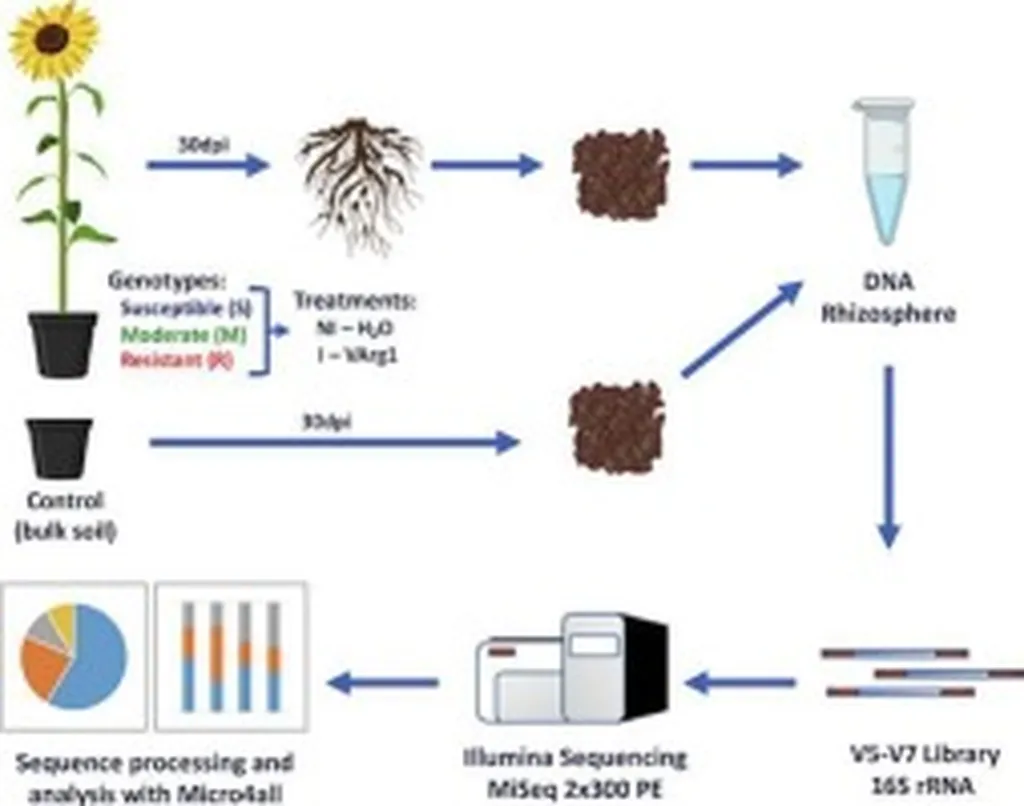
In the quest for sustainable agriculture, scientists are increasingly turning to the microscopic world for solutions. A recent study published in *Current Research in Microbial Sciences* has shed light on how beneficial bacteria can influence the microbial communities associated with sunflower plants, potentially paving the way for more resilient and productive crops.
The research, led by Chiara Braglia from the University of Bologna, focused on the impact of three microbial consortia—comprising Bacillus, Lactobacillaceae, and Paenibacillus—on the rhizosphere (the soil surrounding the roots) and root endophytic (internal) microbiota of two sunflower genotypes: a hybrid (LST907 – Olival) and an open-pollinated variety (Peredovick). The study spanned two consecutive growing seasons, providing a robust dataset for analysis.
Using high-throughput 16S rRNA amplicon sequencing, the team discovered that the administration of Plant Growth Promoting Bacteria (PGPB) significantly modulated the microbial communities. The effects were not uniform, however, with strong genotype- and year-specific responses observed. “The inoculants selectively enriched key beneficial taxa, such as Pseudomonadaceae, Streptomycetaceae, Lactobacillaceae, and Comamonadaceae, while depleting others like Chitinophagaceae and Micromonosporaceae,” Braglia explained. This suggests a functional shift in the microbiome composition, which could enhance plant health and resilience.
One of the most intriguing findings was the enhanced connectivity between taxa in the endosphere and rhizosphere niches under inoculated conditions. This was particularly evident in the Peredovick variety, indicating that the sunflower genotype plays a central role in mediating these microbiome shifts. “Several microbial families showed consistent cross-niche associations across years, suggesting robust and reproducible inoculant effects,” Braglia noted.
The study also revealed that specific microbial families acted as key drivers of treatment-related variance, highlighting the potential for targeted microbiome management. Principal Component Analysis confirmed clear structural shifts in both rhizosphere and endosphere communities, underscoring the influence of PGPB on microbial diversity and assembly dynamics.
The commercial implications of this research are substantial. By understanding how PGPB can shape microbial communities, farmers and agritech companies can develop tailored inoculants that enhance crop performance. This could lead to more sustainable agricultural practices, reducing the need for chemical fertilizers and pesticides. “Our results support the development of genotype-adapted microbial inoculants to modulate plant microbiomes with enhanced functional potential,” Braglia said. This could be a game-changer for the agriculture sector, particularly in the face of climate change and the increasing demand for sustainable food production.
Looking ahead, this research opens up new avenues for exploring the interactions between plants and their associated microbiomes. Future studies could delve deeper into the functional roles of specific microbial taxa and their impact on plant health and productivity. Additionally, the development of genotype-specific inoculants could revolutionize precision agriculture, allowing for more targeted and effective crop management strategies.
In conclusion, this study provides compelling evidence that PGPB not only shape microbial diversity but also influence microbiome assembly dynamics in the root endosphere and rhizosphere niches. As we continue to unravel the complexities of these interactions, the potential for enhancing crop resilience and sustainability becomes increasingly clear. The findings, published in *Current Research in Microbial Sciences* and led by Chiara Braglia from the University of Bologna, represent a significant step forward in our understanding of plant-microbiome interactions and their applications in sustainable agriculture.