
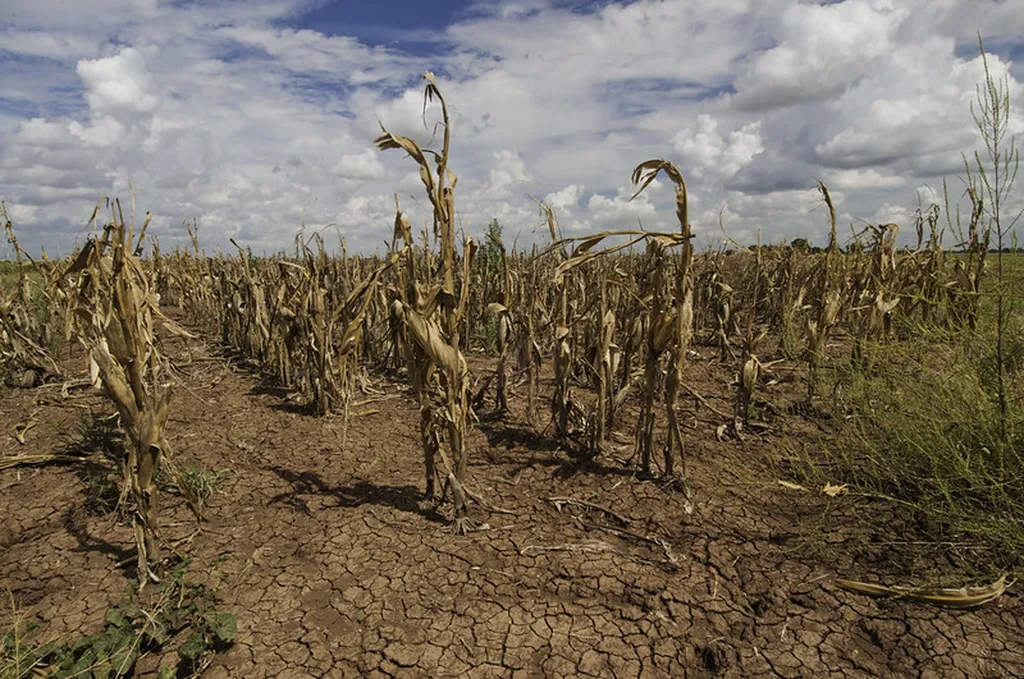
In the heart of the Contiguous United States (CONUS), a silent crisis is brewing, one that could reshape the agricultural landscape as we know it. A recent study published in *Agricultural Water Management* sheds light on the increasing irrigation water requirements (IWR) across croplands, painting a stark picture of the challenges farmers might face in the coming decades.
The research, led by Haoxuan Yang from the Department of Natural Resource Ecology and Management at Oklahoma State University, projects a significant rise in IWR throughout the 21st century. Using climate projections from five general circulation models within the Coupled Model Intercomparison Project Phase 6 (CMIP6), Yang and his team analyzed temporal trends and spatial patterns of IWR under two Shared Socioeconomic Pathways: a moderate warming scenario (SSP245) and a severe warming scenario (SSP585).
The findings are clear: irrigation demands are set to increase. Under the moderate scenario, the annual average IWR depth is expected to reach 404.4 mm/yr by the late 21st century, a 10.3% increase from the early 2000s. However, under the severe warming scenario, the rise is even more dramatic, with IWR depth projected to reach 462.7 mm/yr, a 26.4% increase. “Each 1°C increase in annual temperature is associated with a 4.2–5.0% increase in IWR,” Yang notes, underscoring the direct impact of climate change on agricultural water needs.
The implications for the agriculture sector are profound. With approximately 42% of total freshwater withdrawals in the U.S. devoted to irrigation, the increasing IWR could exacerbate pressures on water availability, potentially leading to higher operational costs for farmers and increased competition for water resources. The study highlights that rice, alfalfa, and cotton are among the crops with the highest IWR per unit cropland area, suggesting that farmers growing these crops may need to adapt their practices or seek alternative water management strategies.
Regionally, the Southern Great Plains and the Midwest are expected to record the highest total IWR amounts, while the Southwest faces the highest IWR depth per unit cropland area. These disparities could lead to uneven impacts across the country, with some regions potentially facing more severe water shortages than others.
The study’s projections serve as a wake-up call for the agriculture sector. As Yang points out, “These results underscore the growing challenges irrigation faces under changing climate conditions and highlight the urgent need for effective water use strategies that ensure sustainable agricultural production and food security.” The research could shape future developments in the field, prompting investments in water-efficient technologies, improved irrigation practices, and policies that promote sustainable water use.
In the face of these challenges, innovation and adaptation will be key. Farmers, policymakers, and researchers must collaborate to develop and implement strategies that can mitigate the impacts of increasing IWR. The study published in *Agricultural Water Management* serves as a crucial step in this direction, providing valuable insights that can guide the agriculture sector towards a more sustainable future.