
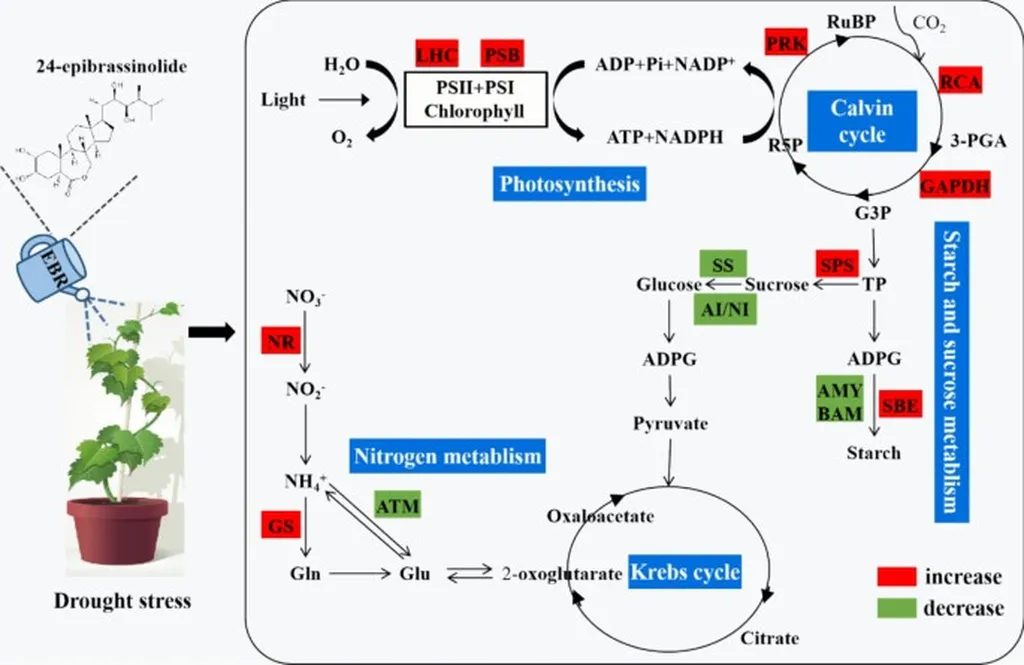
In the quest to bolster crop resilience and productivity under water-scarce conditions, a recent study published in *بوم شناسی کشاورزی* offers promising insights for the agriculture sector. Researchers led by Sulmaz Samfar from the Department of Agronomy and Plant Breeding at Yasouj University have demonstrated that foliar application of 24-epibrassinolide can significantly enhance the growth and yield of pinto beans, even under severe drought stress.
Pinto beans, a staple legume crop, are highly sensitive to drought, which can drastically reduce yield and economic returns for farmers. The study, conducted at Yasouj University’s Research Farm, explored the effects of different irrigation levels and foliar applications of 24-epibrassinolide, a plant growth regulator known for its stress-mitigating properties.
The findings were striking. Severe drought stress, which reduced leaf area index and plant height by nearly 47% and 19% respectively, was significantly counteracted by the application of 0.2 mg L⁻¹ of 24-epibrassinolide. This treatment boosted leaf area index by 14.86% and plant height by 22.80% compared to the control. “The improvements in morphological traits were quite remarkable,” noted lead author Sulmaz Samfar. “This suggests that 24-epibrassinolide can help plants maintain their growth even under limited water availability.”
The benefits extended to yield components as well. Under severe drought, the number of pods per plant, seeds per pod, and hundred-seed weight all saw notable declines. However, the application of 0.2 mg L⁻¹ 24-epibrassinolide reversed these trends, increasing these parameters by 105%, 61.56%, and 26.54% respectively. The interaction between drought stress and the foliar treatment also led to significant improvements in seed yield, biological yield, and harvest index, with the highest water use efficiency recorded under severe drought conditions combined with the 24-epibrassinolide application.
These results underscore the potential of 24-epibrassinolide as a tool for enhancing drought tolerance in pinto beans, a crop vital for food security and sustainable agriculture. “This research highlights the critical role of plant growth regulators in optimizing crop performance under water-limited environments,” said Samfar. “It offers a promising strategy for farmers to maintain yield and profitability in the face of increasing water scarcity.”
The commercial implications of this research are substantial. As water resources become increasingly strained, techniques that improve water use efficiency and crop resilience will be invaluable. The integration of deficit irrigation practices with exogenous brassinosteroid application could become a standard approach in arid and semi-arid regions, helping to ensure stable yields and economic viability for farmers.
Looking ahead, this study paves the way for further exploration of plant growth regulators in enhancing crop resilience. Future research could delve into the optimal application rates and timing for different crops and climatic conditions, as well as the potential synergistic effects of combining multiple growth regulators. As the agriculture sector continues to grapple with the challenges of climate change, innovations like these will be crucial in shaping a more sustainable and productive future.
For now, the findings from Yasouj University provide a beacon of hope, demonstrating that with the right strategies, crops can thrive even in the face of adversity.