
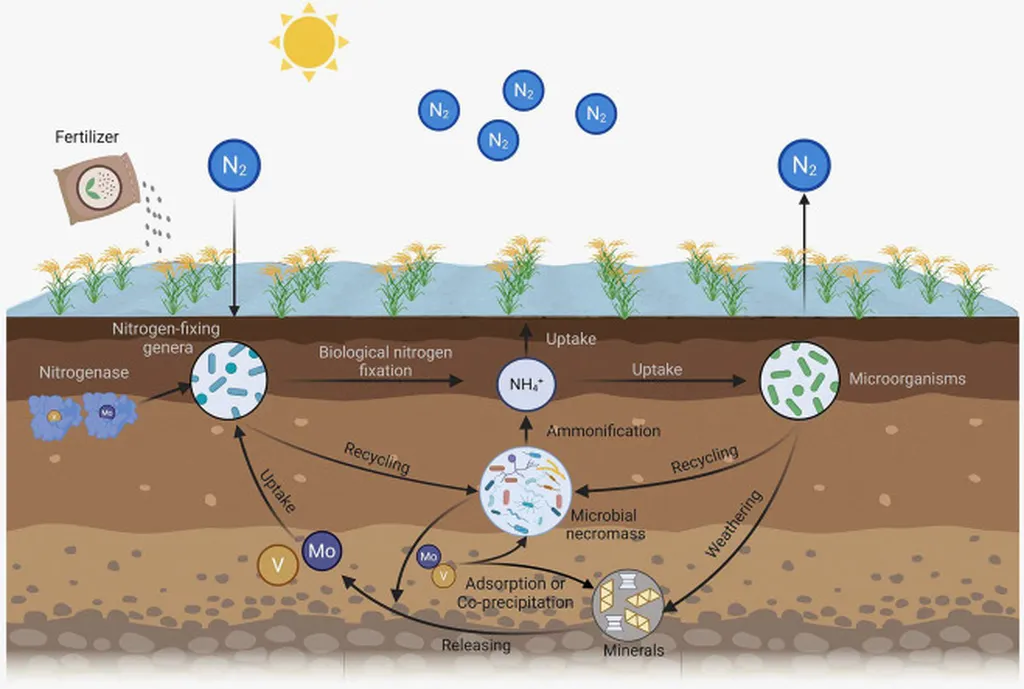
In the heart of China, a team of researchers led by Li-Xin Xu from Tianjin University has uncovered a fascinating interplay between microbial necromass, iron minerals, and micronutrients in paddy soils, with significant implications for agriculture. Their findings, published in the journal *Fundamental Research*, shed light on how long-term fertilization practices can enhance biological nitrogen fixation (BNF), a process crucial for sustainable crop production.
Paddy fields, the largest anthropogenic wetlands on Earth, are prone to micronutrient loss due to frequent irrigation and drainage cycles. These losses can hinder BNF, a natural process that converts atmospheric nitrogen into a form that plants can use. “We’ve known that micronutrients are vital for BNF, but we haven’t fully understood how they’re retained in paddy soils,” Xu explains.
The team found that long-term application of fertilizers increased the contents of microbial necromass—dead microbial biomass—in paddy soils by 20% to 43% compared to unfertilized controls. This necromass, along with short-range ordered minerals, played a key role in retaining micronutrients. “Microbial necromass acts as a reservoir of micronutrients,” Xu says. “It’s a game-changer in understanding how to manage BNF in paddy soils.”
Using advanced techniques like synchrotron radiation-based spectromicroscopy and metagenomic sequencing, the researchers found that the content and bioavailability of micronutrients were strongly correlated with the abundance of key N-fixing genera, such as Azospirillum and Bradyrhizobium. Structural equation modeling revealed that microbial necromass exerted the strongest control on these N-fixing genera.
The commercial implications of this research are substantial. By understanding how to retain micronutrients in paddy soils, farmers can enhance BNF, reducing the need for synthetic nitrogen fertilizers. This not only cuts costs but also promotes more sustainable agricultural practices. “This research offers significant implications for managing BNF in paddy soils,” Xu notes. “It’s a step towards more efficient and eco-friendly agriculture.”
The findings also pave the way for future developments in agritech. As we strive for more sustainable farming practices, understanding the intricate relationships between soil microbes, minerals, and nutrients becomes ever more critical. This research could lead to the development of new fertilization strategies and soil amendments that enhance micronutrient retention and BNF, ultimately boosting crop yields and reducing environmental impact.
In the quest for sustainable agriculture, every discovery counts. This research from Tianjin University is a significant step forward, offering a deeper understanding of the complex dynamics at play in our soils. As we continue to explore these interactions, we move closer to a future where agriculture is not just productive but also sustainable and environmentally friendly.