
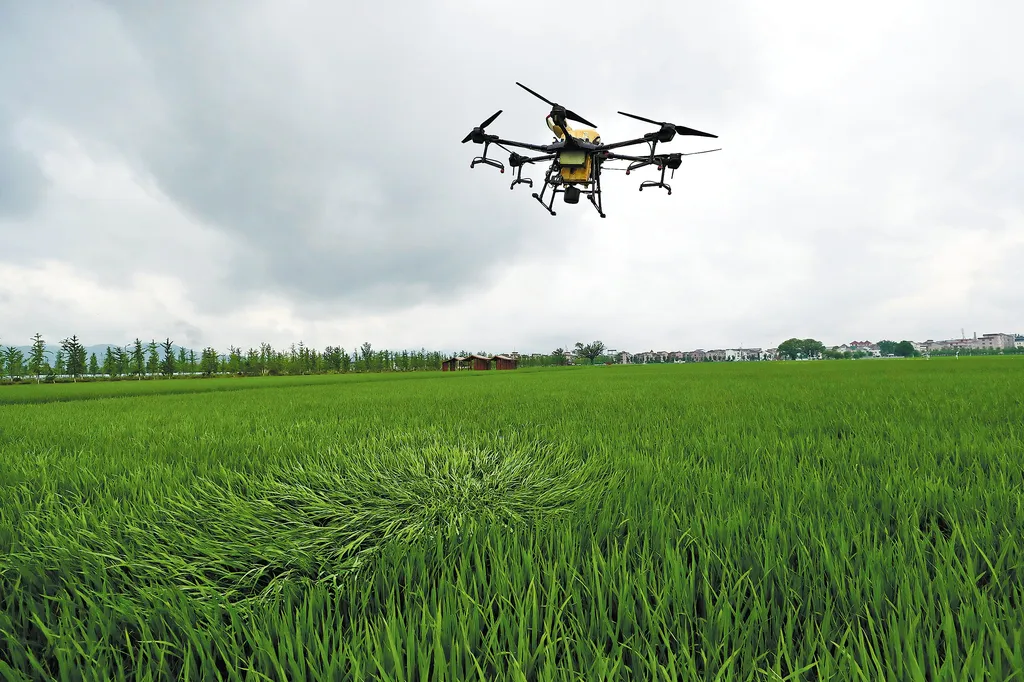
In the heart of China’s agricultural landscape, a groundbreaking study is set to revolutionize how farmers monitor and manage one of their most vital crops: rice. Researchers have developed a cutting-edge method to detect lodged rice—where plants bend or fall over—using unmanned aerial vehicles (UAVs) equipped with multispectral cameras. This innovation, published in *Smart Agricultural Technology*, promises to enhance food security and economic returns for farmers by providing precise, real-time data on crop health.
Rice lodging is a significant challenge for farmers, reducing mechanical harvesting efficiency and impacting both yield and grain quality. Accurate identification of lodged areas is crucial for timely intervention and mitigation. Led by Qiang Chen from the College of Engineering at Nanjing Agricultural University and the College of Biosystems Engineering and Food Science at Zhejiang University, the research team employed deep learning models to analyze high-resolution, multi-temporal images captured by DJI Mavic 3 M and M300 UAVs over paddy fields in Yuhang District, Zhejiang Province.
The study compared two deep learning models: U-Net with a VGG-16 backbone and DeepLabv3+ with a MobileNetv2 backbone. The U-Net model emerged as the superior performer, achieving a mean Intersection over Union (MIoU) of 91.57% and a mean Pixel Accuracy (MPA) of 95.83%. “The U-Net model not only offers high accuracy but also demonstrates strong generalization and stability,” Chen noted. This model’s ability to minimize relative error, with a maximum deviation of less than 3% compared to ground-truth measurements, underscores its practical applicability in agricultural disaster monitoring and precision management.
The implications for the agriculture sector are profound. By leveraging UAV remote sensing and deep learning, farmers can gain real-time insights into crop health, enabling them to make informed decisions that enhance productivity and reduce losses. “This technology provides a reliable technical foundation for agricultural disaster monitoring and precision management,” Chen explained. The study’s findings suggest that the U-Net model could become a standard tool for monitoring rice lodging, offering a scalable solution for large-scale farming operations.
As the agriculture industry continues to embrace technological advancements, this research paves the way for future developments in precision agriculture. The integration of UAV remote sensing and deep learning models holds the potential to transform how farmers manage their crops, ultimately contributing to global food security and economic stability. With the U-Net model’s proven accuracy and reliability, the future of agricultural monitoring looks brighter than ever.