
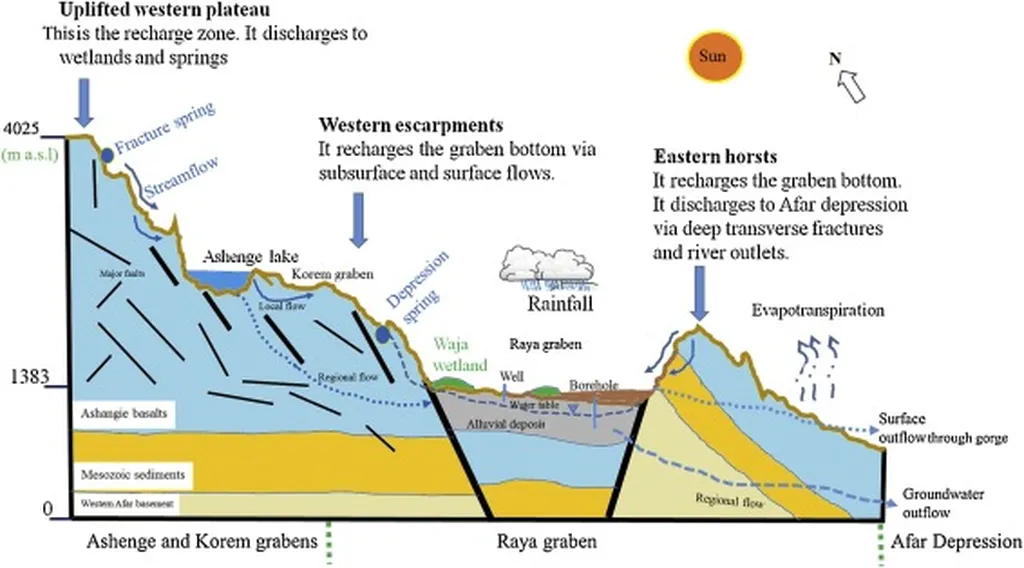
In the heart of northern Ethiopia, the Raya Valley is a lifeline for agriculture and rural communities, its sustenance drawn from the precious groundwater beneath its surface. Yet, the complex geology of this region, nestled along the western margin of the Afar Rift, has made understanding and managing its aquifers a formidable challenge. A recent study published in the *Journal of Hydrology: Regional Studies* by Solomon Salih of Addis Ababa University’s School of Earth Sciences, offers a promising breakthrough, combining geoelectrical and hydrogeological data to characterize the valley’s aquifers with unprecedented precision.
The study’s significance lies in its innovative approach to integrating Vertical Electrical Sounding (VES) measurements with well logs, a method that could revolutionize how we assess groundwater resources in structurally complex regions. “By leveraging these datasets, we were able to derive key hydraulic properties such as hydraulic conductivity and transmissivity, which are critical for understanding the groundwater potential of the area,” explains Salih. This integration not only provides a clearer picture of the aquifers but also offers a cost-effective and efficient tool for future assessments.
For the agriculture sector, the implications are profound. The Raya Valley’s aquifers, primarily composed of alluvial sediments and fractured basalts, exhibit moderate to high groundwater potential. This means that farmers and agricultural enterprises can rely on more accurate predictions of water availability, enabling better planning and sustainable use of this vital resource. “The strong empirical relationships we derived from the data confirm that VES measurements can be a reliable predictor of aquifer properties,” says Salih. “This is a game-changer for regions like the Raya Valley, where groundwater is the backbone of agriculture.”
The study’s findings also highlight the importance of local petrophysical calibration, ensuring that the methodology is tailored to the specific geological context of the region. This localized approach could set a precedent for similar rift-related environments around the world, offering a blueprint for sustainable groundwater management. “Our methodology provides a validated, cost-effective way to assess aquifers, which is crucial for the long-term viability of agriculture in these areas,” Salih adds.
As the world grapples with the challenges of climate change and water scarcity, the insights from this research are timely and relevant. By combining geoelectrical and hydrogeological data, the study not only advances our understanding of aquifer properties but also paves the way for more informed and sustainable agricultural practices. The Raya Valley’s journey towards water security serves as a beacon of hope for other regions facing similar challenges, demonstrating the power of innovative science in shaping a more resilient future.