
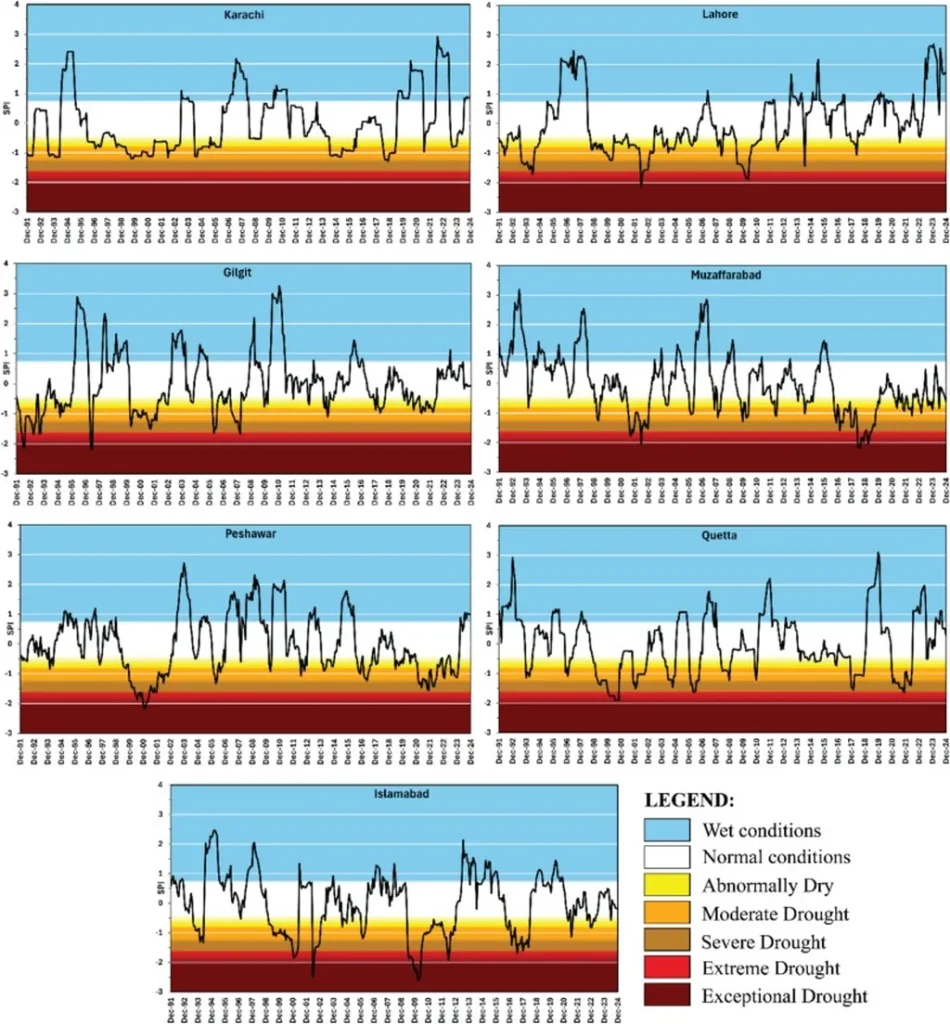
In the face of escalating climate challenges, a groundbreaking study published in *Climate Services* offers a beacon of hope for farmers and policymakers in Pakistan. The research, led by Muhammad Ashraf from the Department of Disaster Management and Development Studies at the University of Balochistan Quetta, introduces an innovative climate service designed to forecast agrometeorological droughts with unprecedented accuracy. By leveraging Seasonal Autoregressive Integrated Moving Average (SARIMA) models, the study projects the Standardized Precipitation Index (SPI) over 6- and 12-month periods, providing critical insights for seasonal risk management.
The study’s findings are particularly timely, given the increasing frequency of extreme weather events that threaten Pakistan’s agriculture sector, which employs 62% of the workforce. “Our research aims to enhance the capacity for anticipating drought conditions, facilitating more effective agricultural management and decision-making in response to potential water scarcity,” Ashraf explains. The study utilized monthly precipitation data from 20 sites between 1991 and 2024 to assess historical drought occurrences and project seasonal conditions for the agricultural period from 2025 to 2030 and long-term conditions up to 2050.
The best-fit SARIMA models demonstrated high accuracy, with validation R² values ranging from 0.86 to 0.94 and RMSE values between 0.31 and 0.49 across meteorological stations. The projections reveal a concerning trend: prolonged mild drought conditions (SPI: −1.3 to −1.7) are expected during the Rabi season in Punjab and Sindh from 2025 to 2050. Balochistan, already grappling with severe droughts, is projected to face even more arid conditions, with the SPI reaching −2.1 by 2028.
The commercial implications for the agriculture sector are profound. Accurate drought forecasting enables farmers to adopt climate-smart management practices, such as promoting drought-tolerant crop varieties and implementing high-efficiency irrigation systems. This proactive approach can mitigate yield reductions of 25%–35% in drought-prone agrometeorological zones, ensuring food security and economic stability.
Moreover, the study’s early warning system provides policymakers with a vital tool for seasonal risk assessment. “Our research will enable policymakers to prioritize resource allocation, thereby improving the resilience of rain-fed agricultural systems,” Ashraf notes. This foresight is crucial for a sector that is the backbone of Pakistan’s economy.
The research not only offers immediate benefits but also paves the way for future developments in agrometeorological services. As climate change continues to intensify, the demand for accurate and timely drought forecasts will grow. This study sets a precedent for integrating advanced statistical models into agricultural planning, fostering a more resilient and adaptive farming community.
In an era where climate-induced disasters are becoming the norm, this research provides a vital tool for mitigating risks and ensuring the sustainability of agriculture. By embracing such innovative approaches, Pakistan can navigate the challenges posed by climate change and secure a prosperous future for its farmers and the broader economy.