
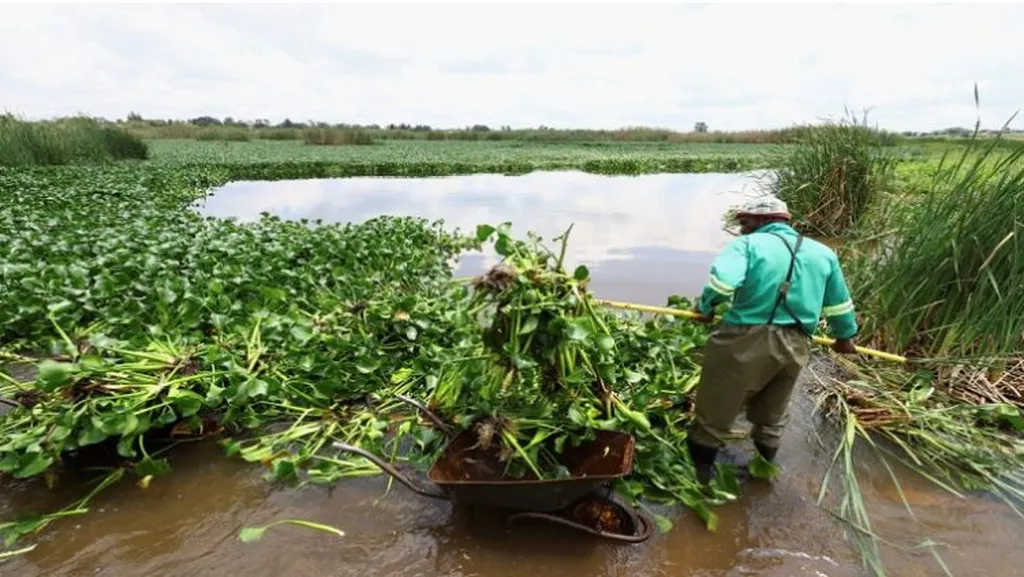
In the heart of South Africa’s struggle against invasive species and water pollution, a glimmer of hope emerges from an unexpected source: the water hyacinth. This invasive aquatic plant, notorious for choking waterways and disrupting ecosystems, is being transformed into a valuable resource through innovative research. A study published in ‘Desalination and Water Treatment’ reveals that water hyacinth can be used to remove nutrients from eutrophic water bodies and produce biochar, offering a sustainable solution to both environmental and agricultural challenges.
The research, led by N.A. Tshikovhi from the Council for Mineral Technology (MINTEK) in Johannesburg, explores the potential of water hyacinth as a raw material for biochar production. Biochar, a carbon-rich product derived from the pyrolysis of organic materials, has gained attention for its ability to improve soil health and sequester carbon. By examining different pyrolysis temperatures, the study found that 500 °C yields biochar with high carbon content, making it an ideal candidate for various applications.
“Water hyacinth is a significant problem in South Africa, but it can also be a valuable resource,” Tshikovhi explains. “By converting it into biochar, we can address both the issue of invasive species and the need for sustainable agricultural practices.”
The study’s findings are particularly relevant to the agriculture sector, where nutrient management and soil health are critical concerns. The biochar produced from water hyacinth is enriched with phosphorus, a nutrient that is often limiting in agricultural soils. This makes it an excellent candidate for soil amelioration, potentially improving crop yields and reducing the need for synthetic fertilizers.
Moreover, the research highlights the potential for circular economy approaches in managing invasive species. By valorizing water hyacinth, the study demonstrates how waste materials can be transformed into valuable resources, contributing to a more sustainable and resilient agricultural system.
“The circular economy is about seeing value in what others might consider waste,” Tshikovhi notes. “Water hyacinth is a perfect example of how we can turn a problem into an opportunity.”
The implications of this research extend beyond South Africa, offering a model for other regions grappling with invasive species and water pollution. As the world seeks sustainable solutions to environmental and agricultural challenges, the valorization of water hyacinth for biochar production presents a promising avenue for innovation and development.
In the quest for sustainable agriculture and environmental stewardship, the humble water hyacinth emerges as an unlikely hero. Through the lens of circular economy and waste valorization, this invasive species is transformed into a valuable resource, offering a glimpse into a more sustainable future. As researchers continue to explore the potential of biochar and other innovative solutions, the agriculture sector stands to benefit from a more resilient and productive landscape.