
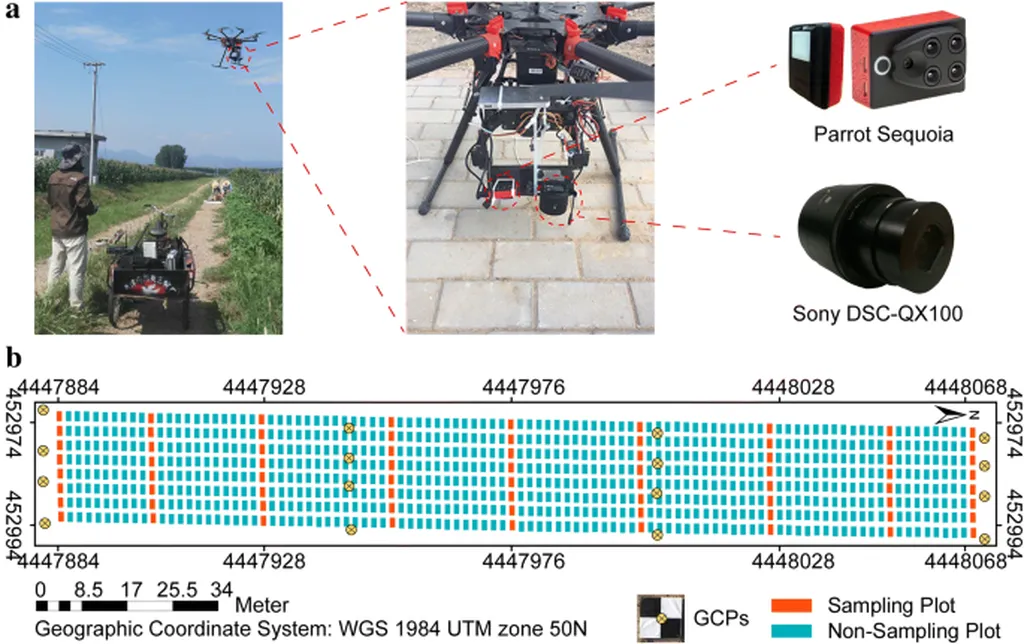
In the ever-evolving landscape of precision agriculture, researchers have introduced a groundbreaking method to estimate maize aboveground biomass (AGB) using unmanned aerial vehicles (UAVs). This innovation, published in *Industrial Crops and Products*, promises to revolutionize how farmers monitor crop growth and predict yields, potentially boosting efficiency and profitability in the agriculture sector.
The study, led by Ying Yang from the School of Geography, Geomatics and Planning at Jiangsu Normal University, introduces a novel parameter called partial pixel integration (PPI). This metric captures both horizontal and vertical structural features of maize at the plot scale, offering a more comprehensive approach than traditional methods that rely solely on spectral indices, texture metrics, or structural features derived from UAV multispectral imagery.
“Previous methods often involved significant uncertainties and ignored overall maize morphological characteristics,” Yang explained. “Our PPI parameter addresses these gaps, providing a more accurate and robust estimation of maize AGB.”
The research involved field experiments conducted in Dafeng District, Yancheng City, Jiangsu Province, China. Multispectral UAV imagery was captured at five different flight altitudes (10 m, 20 m, 30 m, 50 m, and 80 m). Five structural features—fractional vegetation cover (FVC), plant height (PH), FVC × PH, pixel integration (PI), and PPI—were extracted to develop Fresh and Dry AGB estimation models based on linear, exponential, and power functions.
The results were impressive. Models incorporating the PPI parameter outperformed those using other metrics, achieving the highest R² values of 0.968 for Fresh AGB (at 20 m flight altitude) and 0.948 for Dry AGB (at 10 m flight altitude). Notably, Fresh AGB estimation models were generally more accurate than Dry AGB estimation models, and increasing UAV flight altitude did not necessarily reduce AGB prediction accuracy.
“This study demonstrates that the PPI parameter delivers high accuracy and robustness, presenting a novel and reliable approach for in-field maize AGB estimation,” Yang said. “It has the potential to significantly enhance precision agriculture practices, enabling farmers to make more informed decisions about crop management and resource allocation.”
The commercial implications of this research are substantial. Accurate AGB estimation is crucial for monitoring maize growth and predicting yields, which can lead to optimized resource use, reduced costs, and increased productivity. By adopting PPI-based methods, farmers can gain a competitive edge in the market, ensuring they maximize their yields while minimizing waste and environmental impact.
As the agriculture sector continues to embrace technological advancements, the integration of UAVs and innovative parameters like PPI could become a standard practice. This shift not only promises to improve agricultural efficiency but also to contribute to sustainable farming practices, ultimately benefiting both farmers and consumers.
In the words of Ying Yang, “The future of precision agriculture lies in our ability to harness technology and data to make smarter, more sustainable decisions. Our research is a step in that direction, and we hope it inspires further innovation in the field.”