
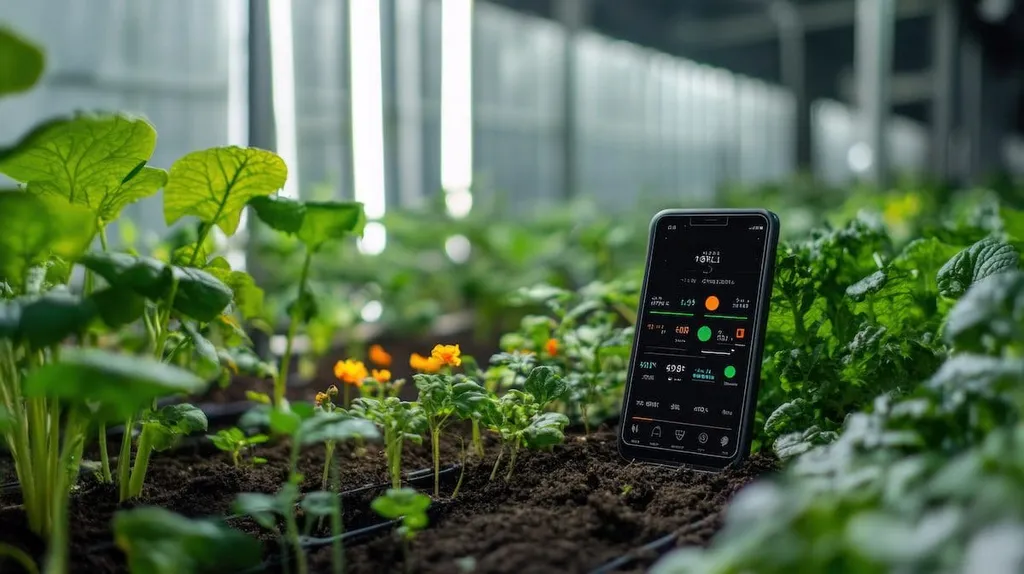
In the ever-evolving landscape of smart agriculture, a groundbreaking development has emerged that promises to revolutionize data collection and analysis in the field. Researchers have introduced AI-SQF, a lightweight framework designed to enhance the efficiency of Mobile Wireless Sensor Networks (MWSNs) in agriculture. This innovation, detailed in a recent article published in *Discover Sensors*, integrates advanced technologies to address the challenges of dynamic data collection in smart farming.
At the heart of this research is the integration of Long Short-Term Memory (LSTM)-based predictive clustering, Q-learning-guided multi-sink mobility, NSGA-II optimization, and grid-based indexing. These components work in tandem to enable real-time SQL-like queries, such as “soil moisture in Zone A, past 10 minutes.” This capability is crucial for farmers and agritech companies seeking to monitor and manage their fields with precision.
“AI-SQF represents a significant leap forward in the field of mobile wireless sensor networks,” said lead author Akanksha Gupta from the Department of Information Technology at Guru Ghasidas Central University. “By leveraging artificial intelligence and advanced optimization techniques, we have created a framework that not only enhances data collection but also ensures high accuracy and freshness of information.”
The framework’s efficiency is evident in its performance metrics. Evaluated in a 2000×2000 meter field using NASA SMAP/MODIS data, AI-SQF achieved impressive results, including a latency of 190±10 milliseconds, a throughput of 13.5±0.6 packets per second, 95.5% coverage, over 91% accuracy, and a data freshness of 2.3±0.25 seconds. These metrics outperform static, KNN, and DRL baselines by 22–50%, demonstrating the framework’s robustness and reliability.
The commercial implications for the agriculture sector are substantial. With AI-SQF, farmers can access real-time data on soil moisture, temperature, and other critical parameters, enabling them to make informed decisions about irrigation, fertilization, and pest control. This level of precision can lead to increased crop yields, reduced water usage, and lower operational costs, ultimately enhancing the sustainability and profitability of agricultural practices.
Moreover, the fault tolerance of AI-SQF ensures that the system can maintain high delivery rates even in the face of node failures, a common challenge in wireless sensor networks. This resilience is crucial for ensuring continuous and reliable data collection, which is essential for effective farm management.
As the agriculture industry continues to embrace smart technologies, innovations like AI-SQF are poised to play a pivotal role in shaping the future of farming. By providing a robust and efficient framework for data collection and analysis, AI-SQF can help farmers and agritech companies optimize their operations, improve crop yields, and contribute to a more sustainable agricultural ecosystem.
The research published in *Discover Sensors* by lead author Akanksha Gupta from the Department of Information Technology at Guru Ghasidas Central University highlights the potential of AI-SQF to transform the way data is collected and utilized in smart agriculture. As the technology continues to evolve, it is likely to become an integral part of the agricultural toolkit, driving innovation and efficiency in the sector.