
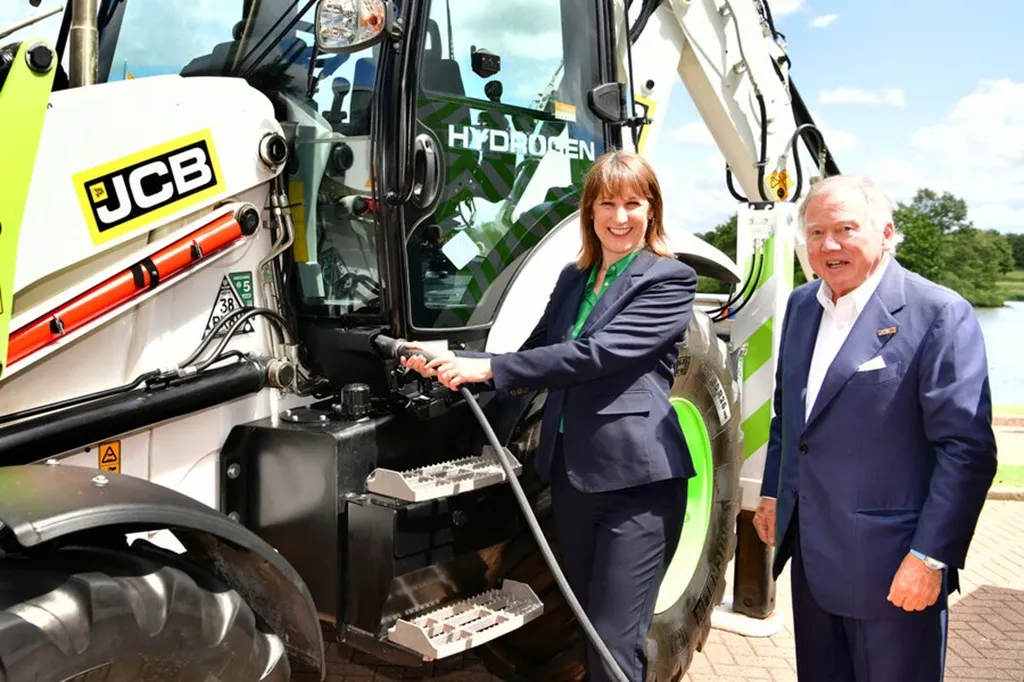
In a significant stride towards decarbonising the farming sector, JCB, the £5.7 billion construction equipment manufacturer, has invested £100 million in developing hydrogen combustion engines that produce zero carbon emissions at point of use. This investment has already borne fruit, with over 130 engines now powering backhoe loaders, telescopic handlers, and trucks. The initiative is spearheaded by Lord Bamford, who envisions a future where red diesel is replaced by hydrogen across the agricultural landscape.
Lord Bamford argues that internal combustion technology adapted for hydrogen offers a more practical solution than fuel cells or batteries for heavy agricultural machinery. “If you want to reduce fossil fuels, there is a proper solution to emissions, and it is there, and it is not costly,” he said. “We are using a technology we know works. We know how to build them. We know how to service them.” This approach stands in contrast to the battery-electric revolution championed by many policymakers.
While JCB produces battery-electric compact machines up to 3.5 tonnes, Lord Bamford contends that batteries are impractical for larger agricultural equipment that operates for extended periods in remote locations. “We are committed to combustion engines because they deliver high power and torque for agricultural applications,” he told the Farmers Guardian. “There is no reason why hydrogen-powered engines will cost any more than what we have now.”
The hydrogen approach offers minimal disruption to farming operations. Hydrogen storage would work similarly to existing diesel tanks, with mobile refuelling taking just three to five minutes. Farmers with renewable energy installations could even produce their own hydrogen through electrolysis, creating what Lord Bamford calls ‘small-scale energy security’.
JCB Power Systems in Derbyshire has assembled a team of 150 engineers to develop the technology, which adapts proven internal combustion engines to run on hydrogen gas instead of diesel, emitting only water vapour from the exhaust. Lord Bamford also highlighted the potential of naturally occurring hydrogen reserves underground, with recent discoveries in Kansas and northern France suggesting vast deposits may exist. “It is highly possible geologically that there is huge quantities underground,” he said.
The Bamford family, whose organic Daylesford farming operation spans 3,400 acres, has extended the vision to retrofitting existing vehicles. Jo Bamford has launched a business focused on re-engineering Europe’s 1.5 million trucks, recognising that vehicles averaging 13 years old will still be operating in 2050 unless their drivetrains are replaced. “We have gone down a drive with electric vehicles of throwing everything away and starting from the beginning,” said Lord Bamford. “Actually, the machine is completely functional if we change its power source.”
The timeline for widespread adoption depends on infrastructure development and achieving price parity with red diesel. Lord Bamford noted that Britain’s electricity costs, currently four times those in the United States, present a significant challenge to hydrogen production costs. As COP30 delegates debate pathways to decarbonise agriculture and transport, JCB’s hydrogen combustion technology offers a solution, added Lord Bamford.