
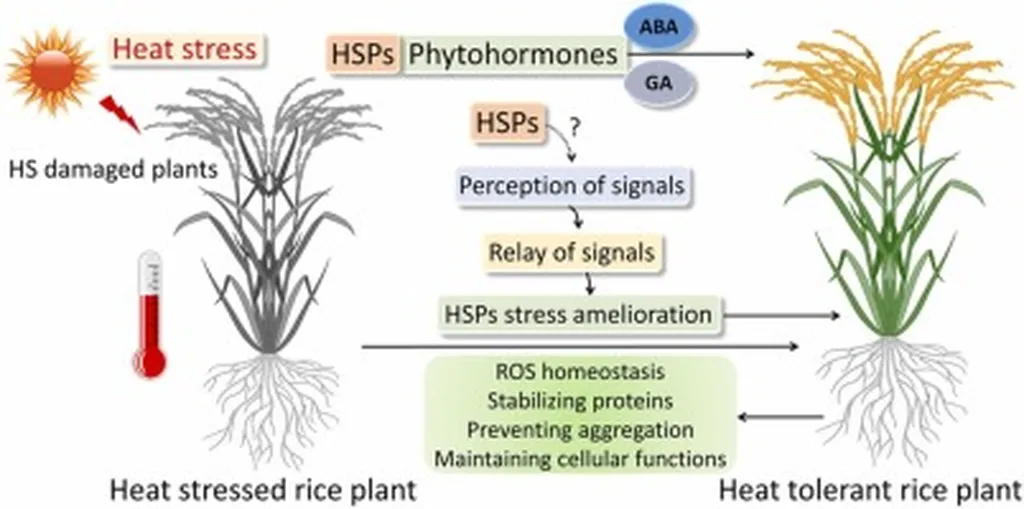
In the face of escalating climate challenges, rice— a staple crop for over half the world’s population—is under increasing threat. A recent study published in *BMC Plant Biology* offers a promising path forward, shedding light on the genetic mechanisms that could bolster rice’s resilience. Led by Nagy S. Radwan of Alexandria University’s Agricultural Botany Department, the research delves into the HSP70 gene family, a group of molecular chaperones crucial for maintaining protein stability under environmental stress.
The study identified and characterized 32 OsHSP70 genes in the rice genome, classifying them into five distinct subfamilies. Notably, subfamily D emerged as the largest, with 15 members, suggesting a significant role in stress response. “The predominance of subfamily D indicates its potential importance in rice’s adaptation to stressful conditions,” Radwan explained. This finding could be pivotal for breeders aiming to develop more robust rice varieties.
One of the most compelling aspects of the research is the identification of seven highly stress-responsive genes, particularly under heat stress. Among these, Os03g50250, or OsHSP70-13, stood out as the strongest responder across multiple stresses. “OsHSP70-13’s broad responsiveness makes it a prime candidate for further study and potential application in breeding programs,” Radwan noted. This discovery could revolutionize the way we approach stress tolerance in rice, offering a targeted approach to enhancing resilience.
The study also revealed that 83% of duplicated gene pairs evolved under purifying selection, indicating strong evolutionary pressure to maintain these genes’ functions. This insight into the evolutionary history of OsHSP70 genes provides a deeper understanding of their role in rice’s adaptation to environmental stresses.
From a commercial perspective, these findings could have significant implications for the agriculture sector. With climate-related stresses on the rise, developing rice varieties with enhanced stress tolerance is more critical than ever. The identification of key genes and their roles in stress response offers a roadmap for breeders and geneticists to create climate-resilient rice varieties. This could lead to more stable yields, improved food security, and economic benefits for farmers worldwide.
Moreover, the study’s integration of bioinformatics and experimental approaches sets a new standard for genetic research in crops. By combining these methods, researchers can gain a more comprehensive understanding of gene function and regulation, paving the way for more targeted and effective breeding strategies.
As we look to the future, this research could shape the development of next-generation rice varieties that are better equipped to withstand the challenges posed by climate change. By harnessing the power of genomics and evolutionary analysis, we can unlock new possibilities for improving crop resilience and ensuring food security for generations to come.
Published in *BMC Plant Biology* and led by Nagy S. Radwan of Alexandria University’s Agricultural Botany Department, this study not only advances our understanding of rice genetics but also offers practical solutions for the agriculture sector. As we continue to face the realities of a changing climate, such research is invaluable in our quest to build a more resilient and sustainable future.