
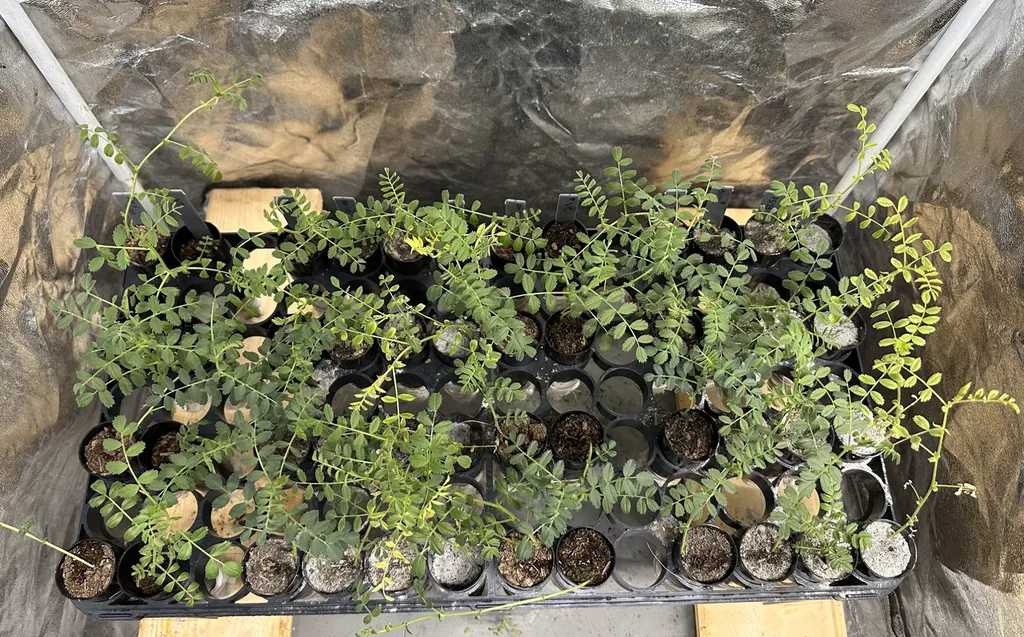
In the quest to establish sustainable food production for long-duration lunar missions, scientists are turning to an unlikely ally: chickpeas. A recent study published in *Frontiers in Astronomy and Space Sciences* explores how different genotypes of chickpeas (Cicer arietinum) can thrive in lunar regolith simulant, paving the way for innovative agricultural practices both on Earth and beyond.
The study, led by Jessica Atkin from the Department of Soil and Crop Sciences at Texas A&M University, investigated how 16 different chickpea genotypes performed in a lunar regolith simulant amended with vermicompost. The research highlights the potential of chickpeas as a robust and nutritious crop for lunar agriculture, thanks to their ability to form symbiotic relationships with beneficial microbes like arbuscular mycorrhizal fungi and rhizobia.
Lunar regolith, the dusty and rocky material covering the Moon’s surface, presents significant challenges for plant growth. It lacks organic matter, beneficial microbes, and has a poor structure, low nitrogen content, and contains phytotoxic metals. However, the study found that chickpeas can overcome these hurdles with the right microbial partnerships. “Chickpeas are an ideal candidate for lunar agriculture because they are a nutritionally dense food source and form symbiotic relationships with beneficial microbes,” Atkin explained. “These relationships help improve nutrient availability, detoxify metals, and enhance soil structure.”
The research revealed considerable variation in biomass production among the different chickpea genotypes, with some genotypes producing up to 116 percent more biomass than others. This variation suggests that specific genotypes may be better suited for regolith-based systems, offering valuable insights for breeding programs aimed at developing crops for challenging environments.
The implications of this research extend beyond lunar missions. On Earth, the findings could revolutionize agriculture in marginal lands, where poor soil conditions limit crop productivity. By understanding how chickpeas and other crops interact with beneficial microbes, scientists can develop strategies to improve soil health and crop resilience in harsh environments.
The study also underscores the importance of in situ resource utilization (ISRU), a concept that involves using local resources to support human activities in space. By leveraging lunar regolith and beneficial microbes, future lunar missions could reduce the need for Earth-supplied resources, making long-duration missions more sustainable and cost-effective.
As we look to the future, the research conducted by Atkin and her team offers a glimpse into the potential of space agriculture. By harnessing the power of microbial partnerships and genetic diversity, we can develop crops that thrive in the most challenging environments, both on Earth and in space. The findings not only advance our understanding of plant-microbe interactions but also open new avenues for innovation in the agriculture sector, ultimately contributing to food security and sustainability.