
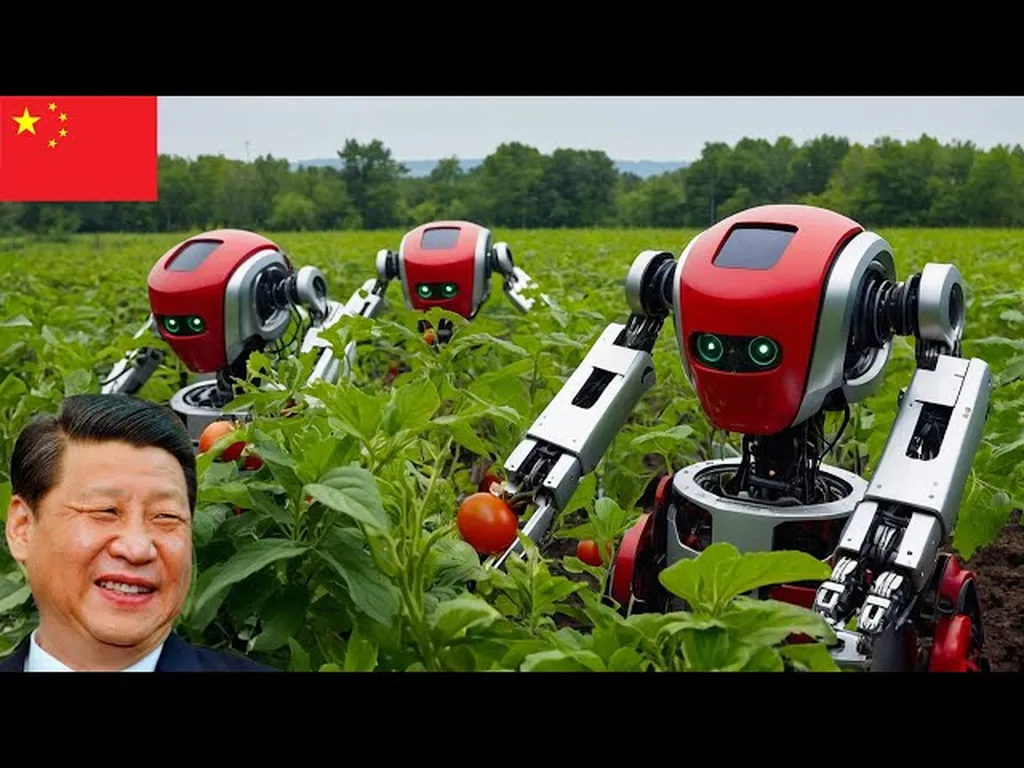
In the heart of China’s agricultural innovation, a groundbreaking study published in *智慧农业* is set to revolutionize the way we think about farming. Researchers from the Institute of Computing Technology at the Chinese Academy of Sciences and the University of Chinese Academy of Sciences have unveiled a comprehensive framework for agricultural multi-robot full-coverage operations, promising to boost efficiency and precision in large-scale farming.
The study, led by Lu Zaiwang and a team of experts, addresses the pressing need for modernizing agriculture through intelligent, data-driven solutions. “With the deepening of intelligent agriculture and precision agriculture, the agricultural production mode is gradually transforming from traditional manual experience-based operations to a modern model driven by data, intelligent decision-making, and autonomous execution,” Lu explains. This shift is crucial for meeting the demands of a growing population and ensuring sustainable food production.
The research focuses on three key aspects: perception and recognition, decision-making and planning, and control execution. By integrating multi-source sensor data, the team has developed a refined global environment model that provides accurate crop status, obstacle distribution, and terrain information. This model is a game-changer for agricultural robots, enabling them to navigate complex and dynamic environments with ease.
At the decision-making level, the researchers have explored advanced methods for task allocation, global path planning, and local path adjustment. Traditional deterministic methods have been replaced with intelligent algorithms that can handle dynamic and complex resource constraints. “Task allocation has evolved from traditional deterministic methods to market mechanisms, heuristic algorithms, and intelligent methods that integrate reinforcement learning and graph neural networks,” the study notes.
The control execution level focuses on model-based trajectory tracking and control technology. Traditional control methods have been optimized to cope with terrain undulations and system disturbances. Intelligent methods such as fuzzy control, neural network control, and reinforcement learning have been gradually applied, further improving the control accuracy and collaborative operation capability of the system.
The commercial impacts of this research are substantial. Agricultural multi-robot systems can significantly reduce labor costs, increase operational efficiency, and improve crop yields. The technology provides practical and feasible intelligent solutions for key links such as sowing, plant protection, and harvesting in large-scale farmland. “The multi-robot full coverage operation technology, with its significant advantages in operation efficiency, system robustness, scalability, and resource utilization efficiency, provides practical and feasible intelligent solutions for key links such as sowing, plant protection, and harvesting in large-scale farmland,” the study highlights.
However, the technology still faces challenges, including perceptual uncertainty, dynamic changes in tasks, vast and irregular work areas, unpredictable dynamic obstacles, communication and collaboration barriers, and energy endurance issues. The researchers emphasize the need for further integration with artificial intelligence, the Internet of Things, and edge computing to overcome these challenges.
As we look to the future, this research paves the way for higher levels of precision, automation, and intelligence in agriculture. The study, led by Lu Zaiwang and his team from the Institute of Computing Technology at the Chinese Academy of Sciences and the University of Chinese Academy of Sciences, is a significant step forward in the quest for sustainable and efficient agricultural practices. The findings, published in *智慧农业*, offer valuable insights and technical paths for related research, shaping the future of modern agriculture.