
In the heart of Iran, where water scarcity is a pressing reality, farmers are facing a critical decision: how to sustain their crops amidst dwindling freshwater resources. A recent study published in *Cleaner Engineering and Technology* offers insights into this challenge, focusing on the adoption of treated wastewater (TWW) for irrigation. The research, led by Moslem Savari from the Department of Agricultural Extension and Education at the Agricultural Sciences and Natural Resources University of Khuzestan, applies the Diffusion of Innovation (DOI) theory to understand farmers’ willingness to embrace TWW.
The study highlights the significant potential of TWW in addressing water scarcity, particularly in agriculture, which consumes a substantial portion of freshwater resources. “The use of treated wastewater offers economic, environmental, and social benefits,” Savari explains. “However, its adoption is not without barriers. Understanding these factors is crucial for promoting sustainable water management practices.”
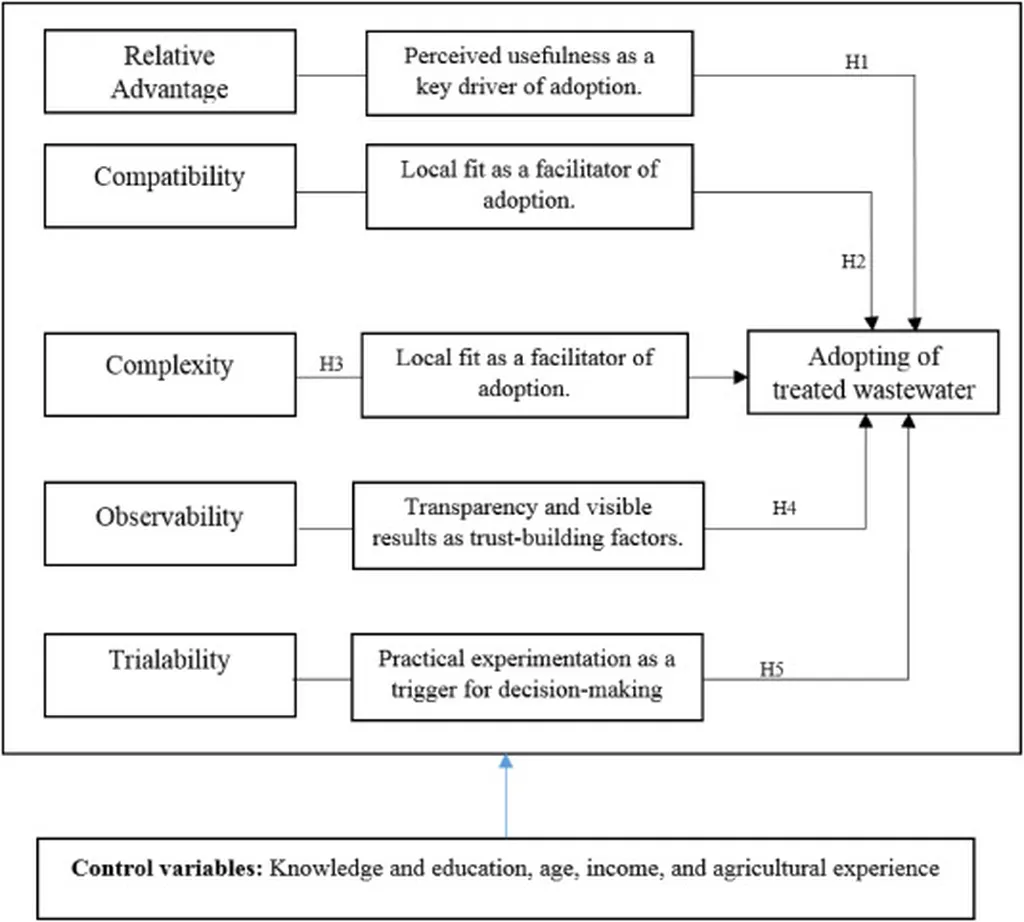
The research employed a structured questionnaire to gather data from farmers in Tehran Province, analyzing the results through structural equation modeling (SEM). The DOI framework proved effective, with all hypothesized relationships showing statistical significance. Key constructs such as relative advantage, compatibility, complexity, observability, and trialability were found to significantly influence farmers’ adoption of TWW.
The findings suggest that farmers are more likely to adopt TWW if they perceive it as advantageous, compatible with their current practices, and easy to understand and trial. “This research provides a valuable foundation for designing extension programs, educational initiatives, and policy support mechanisms,” Savari notes. “By addressing these factors, we can promote the use of alternative water resources and contribute to sustainable agriculture.”
The commercial impacts for the agriculture sector are substantial. Adopting TWW can reduce the pressure on freshwater resources, lower water costs, and enhance environmental sustainability. This shift could also open new markets for water treatment technologies and services, fostering innovation and economic growth in the agritech sector.
While the study offers valuable insights, it is not without limitations. The geographic focus on Tehran Province and the absence of broader cultural, institutional, and economic considerations may constrain the generalizability of the findings. Nevertheless, the research lays the groundwork for future studies and practical applications.
As the world grapples with water scarcity and the need for sustainable development, this study underscores the importance of understanding and addressing the factors influencing the adoption of innovative water management practices. By leveraging the DOI framework and considering individual-level variables, policymakers, educators, and industry leaders can work together to promote the use of TWW and other alternative water resources, ensuring a more sustainable future for agriculture and the environment.