
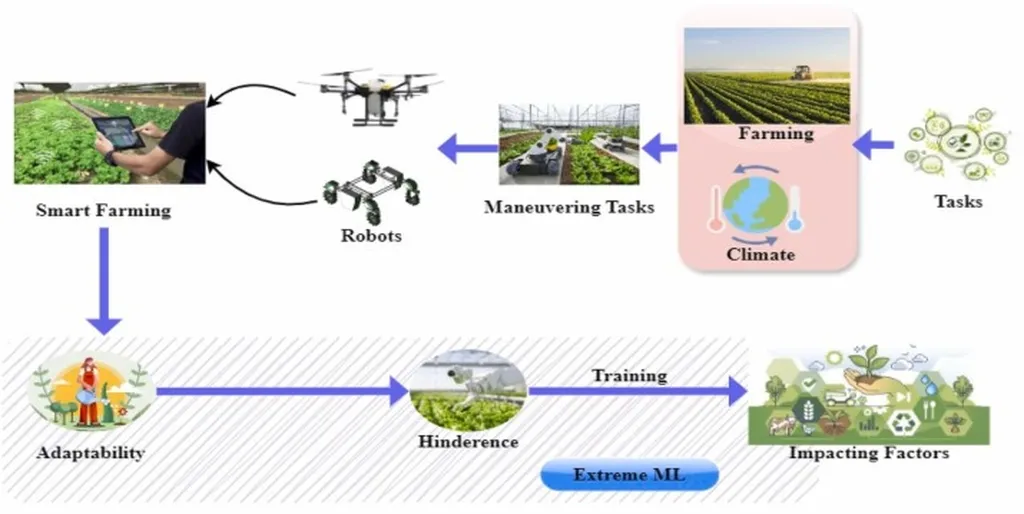
In the rapidly evolving landscape of agricultural technology, a groundbreaking study published in *智慧农业* is shedding light on the transformative potential of multi-agent large language models (LLMs) in modern farming. Led by ZHAO Yingping and a team of researchers from the Shenzhen Modern Agricultural Equipment Research Institute and South China Agricultural University, the research delves into how these advanced systems can revolutionize agricultural intelligence, offering solutions to longstanding challenges in the sector.
Agricultural production is a complex, multi-stage process that involves tillage, planting, management, and harvesting—each stage presenting unique demands and uncertainties. Traditional intelligent systems often struggle to keep up with the dynamic and highly environment-dependent nature of these tasks. Enter multi-agent LLMs, a cutting-edge integration of large language models and multi-agent systems. These models combine deep semantic understanding with distributed collaboration and adaptive coordination, offering a new paradigm for agricultural intelligence.
“Multi-agent LLMs can decompose complex workflows, adapt to changing conditions, and enable robust, full-process automation,” explains LIANG Jinming, a co-author of the study. This capability is particularly valuable in agriculture, where the ability to make intelligent decisions across the entire lifecycle—from planting to harvesting—can significantly enhance efficiency and productivity.
The research outlines the core concepts of multi-agent LLMs, detailing their composition, characteristics, and development pipelines. It also presents the overall architecture of these systems, including the environments in which agents operate and their internal structures. The collaborative patterns of multi-agent LLMs are examined in terms of coordination structures and temporal organization, providing a comprehensive overview of their potential applications.
One of the most compelling aspects of the study is its comparative benchmark survey, which synthesizes benchmark tasks and results from existing studies. The findings reveal that different multi-agent LLM architectures tend to perform better on specific types of tasks, reflecting the influence of design characteristics such as role assignment strategies, communication protocols, and decision-making mechanisms.
The study also reviews several representative architectures of multi-agent LLMs, discussing their potential applicability to agricultural scenarios. For instance, the application architecture of agricultural LLMs is illustrated using rice cultivation as a representative scenario. This process involves data acquisition agents, data processing agents, task allocation and coordination agents, task execution agents, and feedback and optimization agents. Each type of agent plays a crucial role in enabling automated and intelligent operations throughout the agricultural lifecycle.
Despite the promising prospects, the research also highlights several challenges that need to be addressed. These include limited model interpretability, model hallucination, and the complexity of multi-modal agricultural data acquisition and processing. To overcome these hurdles, the study suggests future directions such as enhancing interpretability via chain-of-thought techniques, reducing hallucinations by integrating knowledge bases and verification mechanisms, and standardizing data formats to strengthen cross-modal fusion and reasoning.
The implications of this research for the agriculture sector are profound. By enabling intelligent decision-making across the entire agricultural lifecycle, multi-agent LLMs provide both theoretical foundations and practical tools for building next-generation smart and unmanned farming systems. This technology holds vast promise for the digital transformation, precision management, and sustainable development of agriculture, ultimately shaping the future of the sector.
As the lead authors ZHAO Yingping, LIANG Jinming, CHEN Beizhang, DENG Xiaoling, ZHANG Yi, XIONG Zheng, PAN Ming, and MENG Xiangbao from the Shenzhen Modern Agricultural Equipment Research Institute and South China Agricultural University continue to push the boundaries of this technology, the agriculture sector stands on the brink of a new era of innovation and efficiency. The study, published in *智慧农业*, marks a significant step forward in the integration of advanced technology and agriculture, paving the way for smarter, more sustainable farming practices.