
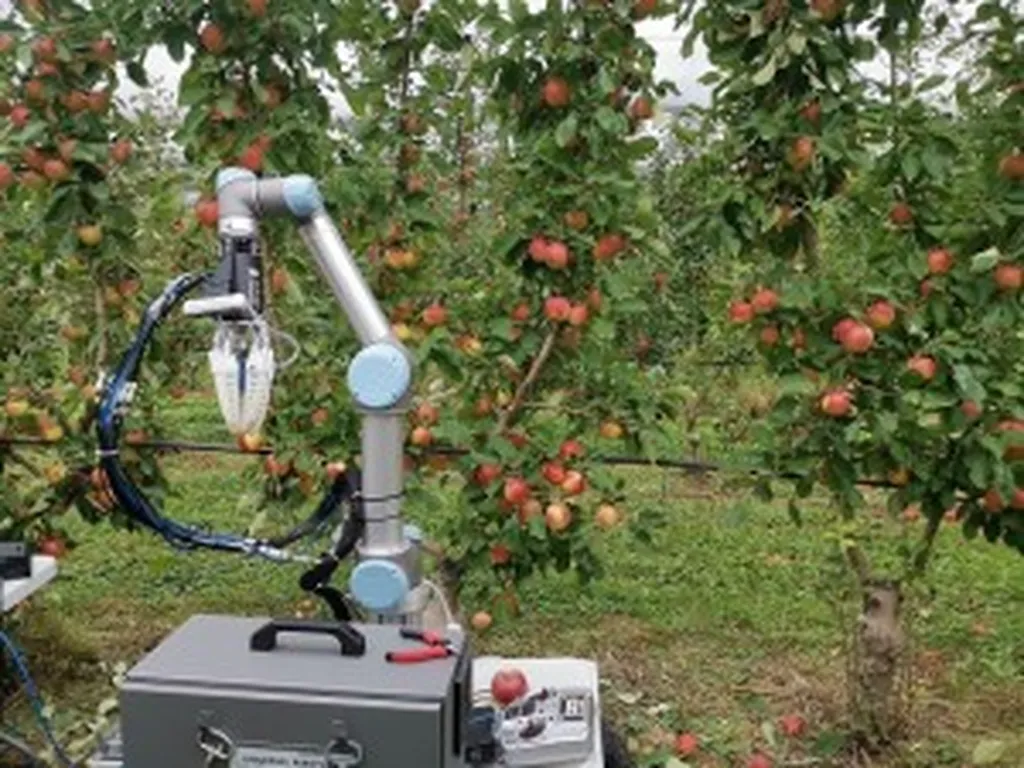
In the ever-evolving landscape of agricultural technology, a groundbreaking study published in *智慧农业* has introduced a novel approach to enhance the capabilities of autonomous apple-picking robots. The research, led by HAN Wenkai and colleagues from the College of Mechanical and Electronic Engineering at Northwest A&F University and the Intelligent Equipment Research Center at Beijing Academy of Agriculture and Forestry Sciences, presents SSW-YOLOv11n, a lightweight instance segmentation model designed to thrive in the complex environments of orchards.
The study addresses a critical challenge in modern agriculture: the need for accurate and efficient fruit detection and segmentation in autonomous harvesting systems. Traditional deep-learning models often fall short due to their high computational demands and limited adaptability to variable field conditions. “Environmental factors like lighting changes, occlusion, and background clutter severely degrade fruit visibility, making it difficult for existing models to perform consistently,” explains lead author HAN Wenkai.
To overcome these hurdles, the researchers developed SSW-YOLOv11n, a model derived from YOLOv11n, optimized for orchard environments. The model incorporates three key innovations: the introduction of GSConv and VoVGSCSP modules into its neck network, the integration of the SimAM self-attention mechanism, and the replacement of the original bounding-box regression loss with Wise-IoU. These enhancements collectively improve the model’s accuracy and efficiency, making it suitable for deployment on resource-limited edge devices.
The results are impressive. SSW-YOLOv11n achieved a Box mAP50 of 76.3% and a Mask mAP50 of 76.7%, representing significant improvements over the baseline YOLOv11n model. Moreover, the model reduced computational complexity by 12.5% and model weight by 22.8%, demonstrating substantial efficiency gains. “Our model not only enhances segmentation accuracy but also ensures real-time performance, which is crucial for the practical application of autonomous apple-picking robots,” notes co-author LI Tao.
The commercial implications of this research are profound. As the agriculture sector increasingly adopts automation to address labor shortages and improve efficiency, the need for robust and efficient fruit detection systems becomes paramount. SSW-YOLOv11n offers a scalable solution that can be integrated into various agricultural robots, paving the way for large-scale orchard automation. “This technology has the potential to revolutionize the way we approach fruit harvesting, making it more efficient, cost-effective, and sustainable,” adds co-author FENG Qingchun.
The study’s findings also highlight the broader potential of deep learning in agriculture. By addressing the dual imperatives of high-precision perception and efficient inference, SSW-YOLOv11n sets a new standard for intelligent agricultural robotics. As the field continues to evolve, similar innovations are likely to emerge, further enhancing the capabilities of autonomous systems in agriculture.
In conclusion, the research published in *智慧农业* represents a significant step forward in the development of autonomous apple-picking robots. By combining lightweight design with advanced attention mechanisms, SSW-YOLOv11n offers a robust technical foundation for the practical application of these systems in complex orchard environments. As the agriculture sector continues to embrace automation, the insights and innovations presented in this study will undoubtedly shape the future of agricultural technology.