
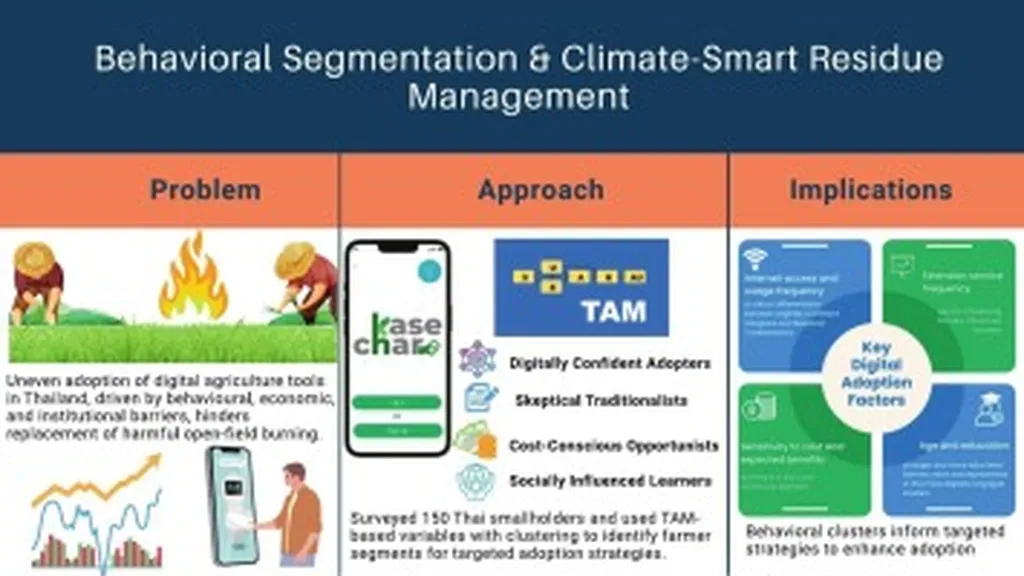
In the heart of Thailand, a groundbreaking study is reshaping how we think about agricultural waste management and technology adoption among farmers. Published in the journal ‘Cleaner and Responsible Consumption’, the research led by Teerapong Pienwisetkaew from the International College at Khon Kaen University, sheds light on the critical role of user experience in driving the acceptance of smart agricultural technologies.
The study explores how farmers respond to different design approaches in smart agricultural waste management systems, focusing on simplicity-oriented versus gamification-oriented designs. By extending the Technology Acceptance Model (TAM) to include user satisfaction (US) as an additional element, the researchers investigated how farmers’ intention to use (IU) these technologies is influenced by perceived ease of use (PEOU), perceived usefulness (PU), user satisfaction (US), and attitude towards use (AT).
The findings reveal that simplicity-driven platform designs significantly enhance perceived usefulness and intention to use, particularly for task-intensive agricultural activities. “Simplicity reduces cognitive load, making it easier for farmers to integrate these technologies into their daily routines,” explains Pienwisetkaew. On the other hand, while gamification components boost user satisfaction and engagement, their impact on perceived usability and overall adoption is more limited.
One of the most compelling aspects of the study is its demonstration that user satisfaction directly drives attitude towards use, which in turn increases intention to use. This underscores the importance of user experience in influencing technology acceptance. “User experience is fundamental in shaping how farmers perceive and adopt new technologies,” Pienwisetkaew emphasizes.
The research also highlights that different farmer profiles respond differently to simplicity and gamification, stressing the need for tailored implementation strategies that align with user characteristics. This insight is crucial for legislators and platform developers aiming to maximize technology adoption in the agricultural sector.
The commercial implications of this research are substantial. By understanding the nuances of technology adoption among farmers, companies can develop more effective and user-friendly smart agricultural waste management systems. This not only enhances sustainability efforts but also boosts productivity and efficiency in the agriculture sector.
Looking ahead, this study paves the way for hybrid design concepts that balance usability and engagement, ultimately driving greater adoption of smart technologies in agriculture. As the world continues to grapple with the challenges of sustainable agriculture, such insights are invaluable in shaping the future of the sector.
For those interested in delving deeper into the study, it is available in the journal ‘Cleaner and Responsible Consumption’, with Teerapong Pienwisetkaew from the International College at Khon Kaen University leading the research efforts. This work not only contributes to the ongoing debate on digital transformation in sustainable agriculture but also provides practical insights for stakeholders looking to make a tangible impact in the field.